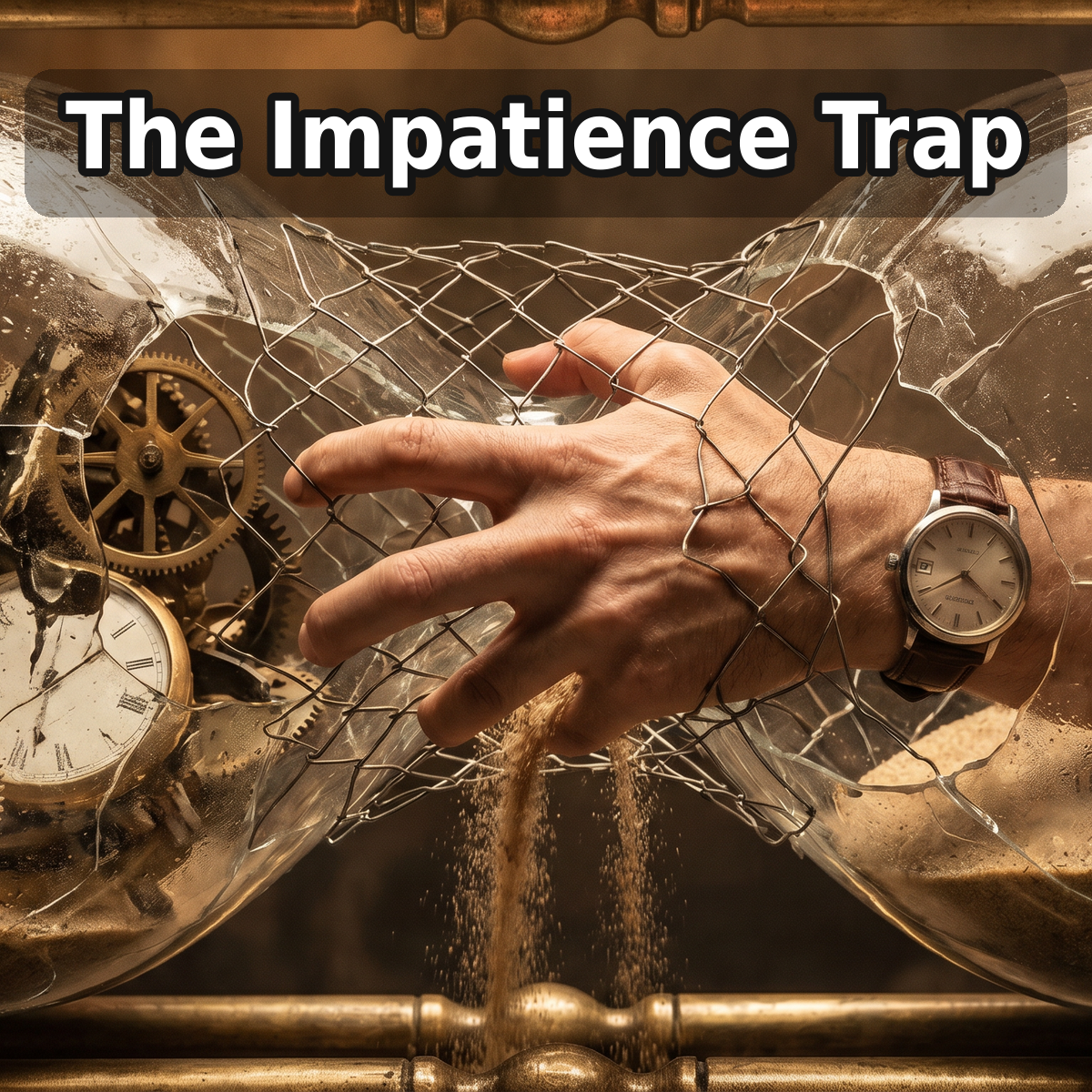
Today I found myself getting impatient with a tool because it was not giving me the result I wanted. I moved to another tool, and then a third, as if the next option might rescue me from the frustration of not getting there fast enough. Then it dawned on me that the problem was not the tool. It was my impatience with waiting long enough to learn what I needed to learn.
I have been contemplating how often this happens.
In the moment, switching tools felt like action. It felt like progress. It gave me the small relief of doing something instead of sitting with the discomfort of not yet knowing enough. But I have come to realize that movement is not always progress, and impatience can wear the mask of productivity.
When Frustration Starts Making Decisions
What frustrated me was not only that I was not getting the result I wanted. It was that I was not getting it on my timeline.
That is an important distinction.
I was asking for an outcome before I had earned the understanding that might produce it. I did not want to stay with the slow part. I did not want to remain in the part where effort still looks clumsy, where the tool feels limited only because my own skill with it is still limited. So I started looking elsewhere.
This repeated pattern led me to an important realization. Many bad decisions are not made because I lack options. They are made because I do not want to tolerate the delay between effort and clarity.
"The problem was not the tool but my impatience with learning enough to use it well."
There is something humbling about seeing that clearly. It removes the excuse. It also puts responsibility back where it belongs.
The False Promise of Switching
Trying a second tool, then a third, created the feeling that I was being resourceful. It looked like adaptation. It looked like problem solving. But if I am honest, it was mostly an emotional response to frustration.
I wanted a different tool to spare me from the discipline of learning.
That is the part I have to watch in myself. Sometimes I confuse novelty with progress. I assume that if something feels hard too early, then something else must be easier, better, or more suited to me. Sometimes that is true. Often it is not. Often the real issue is that I am leaving before understanding has had time to catch up.
I have seen how impatience narrows my thinking. Instead of staying curious, I become reactive. Instead of going deeper, I skim the surface of several options and call it exploration. Instead of making a good decision, I make a quick one.
And quick is not always wise.
What I Need to Do Instead
I have been forced to admit that my impatience tends to lead me into bad decisions because it pushes me away from process and toward escape. It turns learning into a burden when it is actually the path. It makes me evaluate too early, quit too quickly, and blame the wrong thing.
A better response is simpler than I like to admit.
Pause.
Learn one more thing. Try one more variation. Stay with the discomfort a little longer. Let the result take shape through understanding rather than demand that it appear on command. That is not dramatic, but it is honest. It is also, I think, the more conscious application of patience.
When I think back to that moment today, I can still feel the urge to move on, to reach for another tool, to believe the answer is somewhere else. But I have come to realize that the next right step is usually smaller than that. The next right step is to return to the tool in front of me and learn one more thing before I decide it has failed me.