The software development world came to a screeching halt today when the runners hosted in GitHub suddenly stopped serving what are known as actions. About a 6- to 8-hour outage for probably one of the most heavily used services on the Internet. It definitely exposed a bottleneck for many development shops that are becoming increasingly dependent on agentic workflows that automate the process of checking in code changes.
Which is interesting because the reason we use a service like that in the first place is for retention of code revisions to recover from issues and problems associated with the accelerated pace that multiple teams working on the same code base produce. In the IT world, we spend a lot of time worried about bottlenecks in our process.
What is a bottleneck, really? Don’t you always have them? Seems like a matter of perspective. Perhaps it’s less about eliminating them entirely and more about identifying the most restrictive one at any given time. The one that, if addressed, would unlock the greatest immediate improvement. It’s a dynamic target, shifting as you optimize. So, yes, there’s always a bottleneck, but the crucial question is: which one demands your attention now?
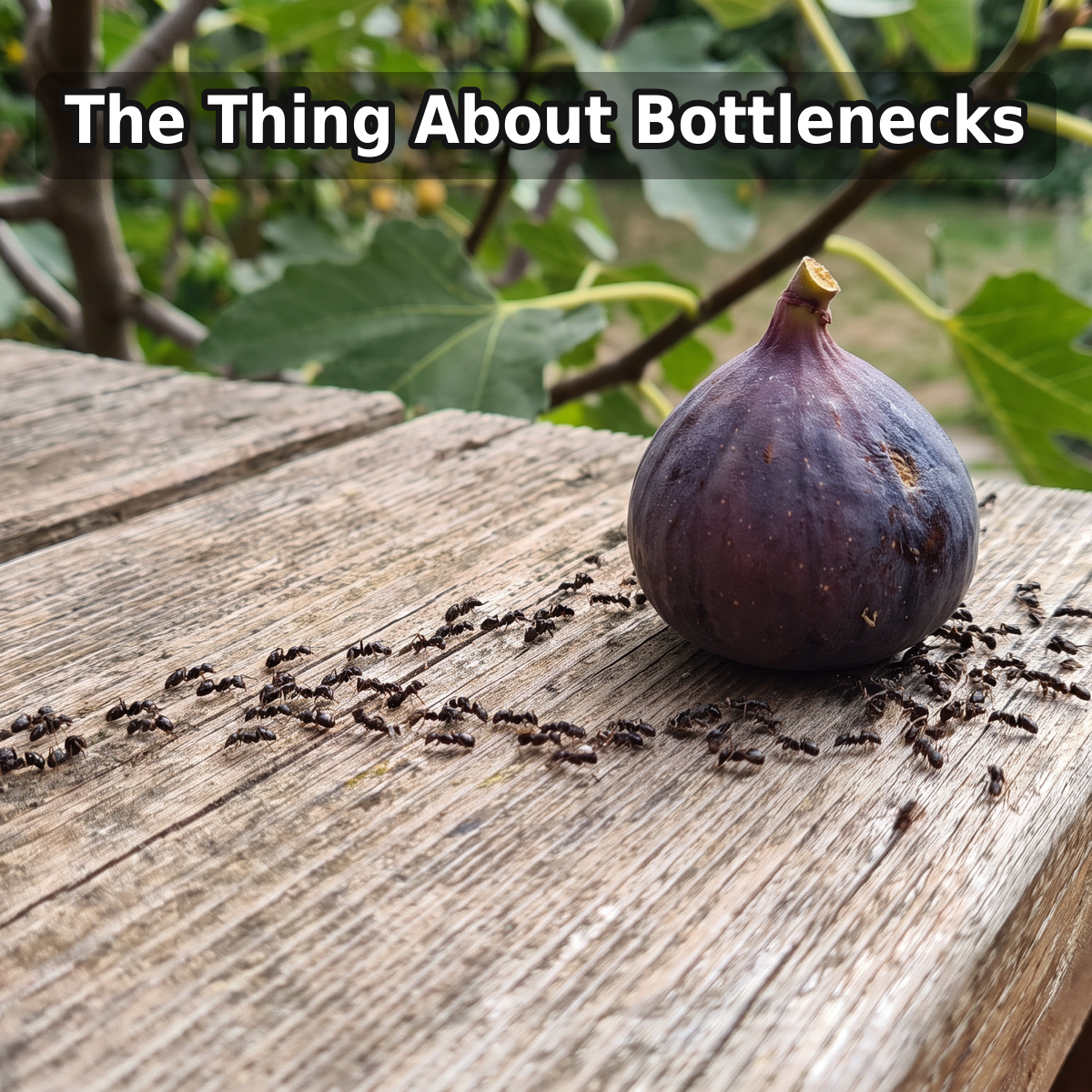
This phenomenon is not just in the development world; it is everywhere. I have a fig tree in my backyard that cranks out an incredible number of figs, and it is impossible to keep that area clean of figs falling to the ground and attracting ants. However, I try. Today, I noticed a stream of ants making their way across my countertop to get to a fig that had fallen near my outdoor sink. They found an interesting path, and I think the entire colony was out collecting the harvest. However, even these industrious ants were facing a bottleneck. The one spot that transitioned to the top part of the counter was narrow, and so only 2 or 3 ants could cross at a time. They had a major jam in their operation, in essence, a bottleneck.
I wondered if they would do anything about it. I watched for a while and got bored. I came back a few hours later, and, sure enough, they had found a second path. Now they had two parallel streams heading toward the countertop bounty. I almost felt bad when I removed the fig and threw it away. Almost. However, if I had left the fig in place, the ants were probably experiencing a bottleneck somewhere else. Perhaps the coffers of food storage back at the colony were jam-packed with ants trying to drop off their payload.
The point is, even ants deal with this problem of ever-continuing bottlenecks. When you clear one, there will always be another. They seem to be about perspective. Once you start growing because you remove one barrier, you will run into the next one. And the general rule seems to be, the larger and faster you get, the bigger and nastier the bottleneck becomes.
So, in essence, we humans all have one thing in common. We are constantly working hard to remove bottlenecks. Remind yourself of that next time you are stuck on the 15 freeway, or waiting in line at the pharmacy, or just admiring the ants trying to help you clear the figs.