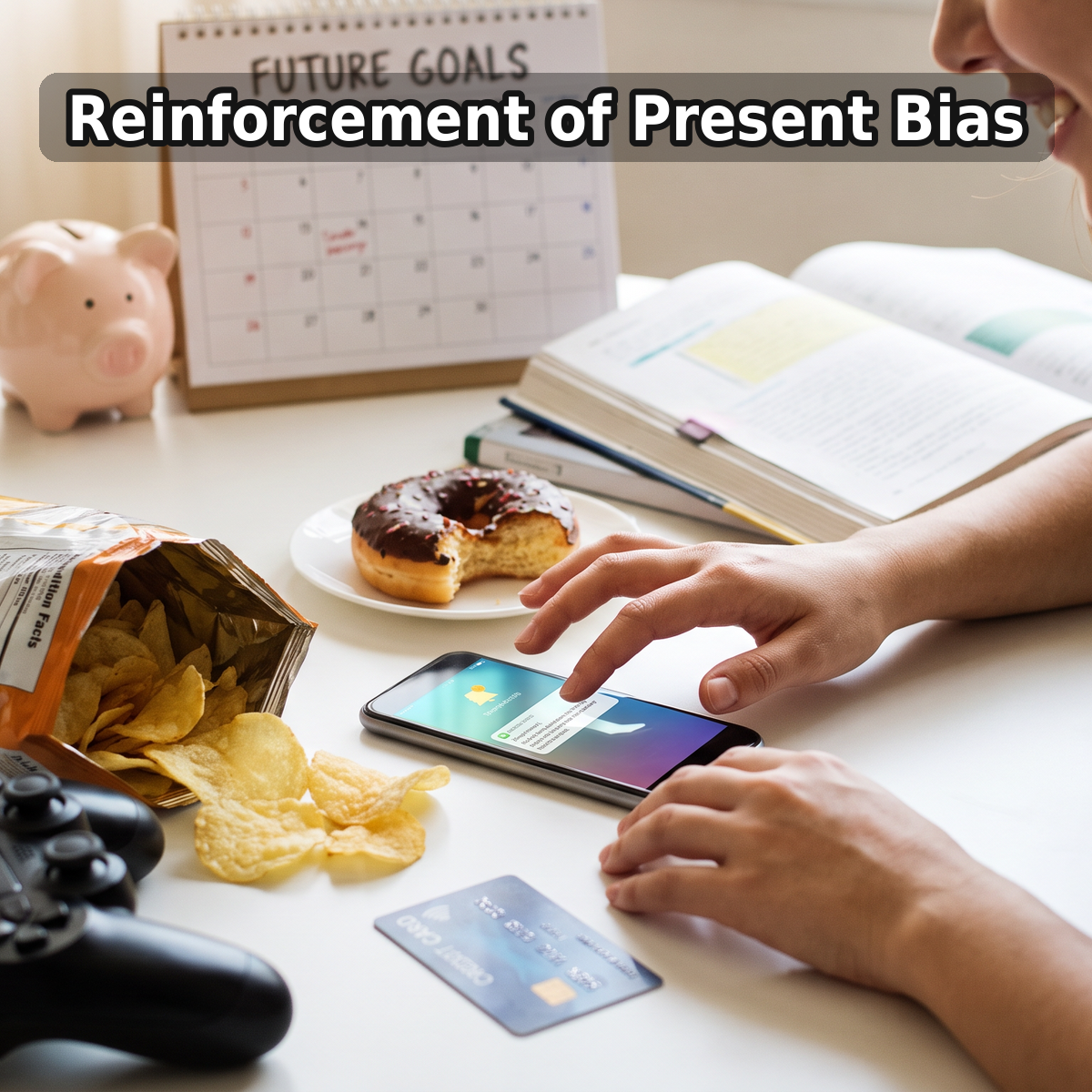
Present bias is the tendency to overvalue rewards available now and undervalue larger benefits that arrive later. In plain terms, people often choose immediate comfort, pleasure, or relief even when waiting would produce a better overall outcome.
Repeatedly choosing the immediate reward can make that pattern feel more automatic, more normal, and more compelling over time. In other words, present-biased choices can become habit-strengthened through repetition, so the short-term option starts to feel like the default rather than a choice that is being actively evaluated.
Here is the problem that we all face, and this is a decision-making process that happens multiple times each day.
An immediate reward is available. The “now” option feels vivid, certain, and emotionally salient, while the future benefit feels abstract and distant.
You choose the immediate reward. That choice often produces quick payoff: pleasure, relief, convenience, reduced effort, or avoidance of discomfort.
The brain learns from the payoff. Behaviors followed by rewarding outcomes tend to become easier to repeat. Even if the long-term result is worse, the short-term reward teaches: “Do this again.”
The behavior becomes more automatic. Over time, less conscious deliberation may be involved. The easy option becomes the familiar route, and the delayed-benefit option starts to feel effortful, unnatural, or even threatening.
Future-oriented choice becomes harder. Not necessarily impossible, but harder, because now you are not only fighting the original attraction of immediate reward, you are also fighting a learned pattern.
Over time, this path of choosing the easier immediate reward becomes “hard-coded.” This is a good metaphor because repeated present-focused choices can create a self-reinforcing behavioral loop. This loop is that immediate reward strengthens the behavior, repeated behavior becomes habit, habit reduces reflection, reduced reflection increases default short-term choice, and repeated short-term choice strengthens present-biased responding again.
That loop makes the immediate option feel increasingly “obvious” and the delayed option increasingly “unnatural.” This aligns with the idea that immediate rewards are valued disproportionately strongly, while delayed rewards are sharply discounted, especially over short time horizons.
A good example of building a habit to pick the immediate reward instead of the longer-term benefit happens all the time in our finances. Consider the daily coffee shop visit. For a few dollars, you get an instant caffeine fix and a moment of indulgence. The longer-term benefit, however, would be to brew coffee at home, saving that money daily. Over a year, those small, immediate rewards add up to a significant sum that could have been invested, used to pay down debt, or saved for a larger goal. The instant gratification of the barista-made latte often trumps the delayed gratification of financial security, illustrating how easily we prioritize the present over the future.
Delayed benefits often have three disadvantages: they are abstract, not vivid right now; they require effort or discomfort now; they are uncertain or psychologically distant.
Meanwhile, immediate rewards are usually concrete, emotionally satisfying, low-friction, available right away. So if someone repeatedly takes the immediate option, they are not just making isolated bad choices. They may be training attention, expectation, and habit to prefer fast payoff.
When you have reinforced this pattern for a long time, it can feel almost insurmountable, especially when the pattern is old, emotionally rewarding, and built into daily routines. But “insurmountable” is not true. Habits can be weakened, and environments can be redesigned. You can fix this. Research suggests several ways to reduce present-biased behavior, including immediate incentives for good behaviors, making future choices in advance, and cooling-off periods before impulsive decisions.
Present bias makes immediate rewards attractive. Repetition makes them habitual. Habit then amplifies present bias by making immediate-reward choices feel automatic and delayed-reward choices feel harder.
Here is another example we all deal with. Suppose someone wants to exercise but keeps scrolling social media instead.
- The scrolling gives immediate stimulation and relief now.
- Exercise gives larger benefits later, but not instantly.
- If the person repeatedly chooses scrolling, the brain learns that boredom or stress should be answered with immediate digital reward.
- Eventually, the conflict is no longer just “scrolling vs. exercise.” It becomes an ingrained response pattern: discomfort → immediate reward.
That is what happens when you continuously reinforce this “present bias.”
Present bias explains the initial pull toward immediate rewards. When you repeatedly choose immediate rewards, you strengthen that bias behaviorally, making delayed-benefit choices feel progressively harder over time.