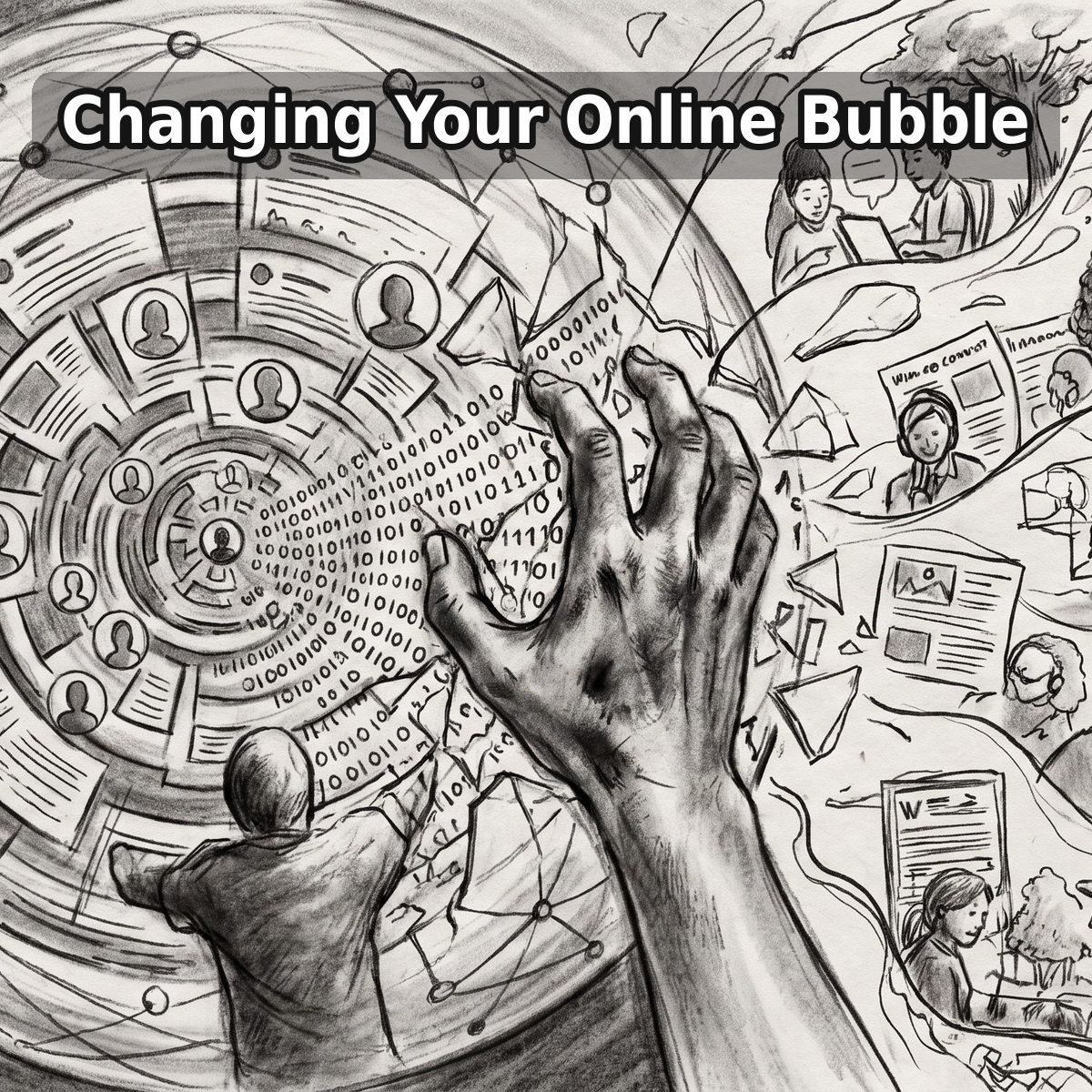
I was sitting around a conference table of people that I had just recently met. We were engaging in a business project. Those people were in business together, married, or friends for a long time. They were very much all locked into the same bubble. You could tell by how the conversations started, "Did you see that article about…" or "Wow, I cannot believe that so and so said that, what is this world coming to?" What was interesting is that I did not know what they were talking about. We were clearly not in the same bubble.
What people probably need to understand is that all social media platforms and advertising systems are built entirely around audience preferences. You are absolutely sending signals out that you are interested in a particular topic. This is not advertisers pinpointing you, although that does happen, it is more your propensity for interest based on what you have been engaging in. You will hear all the social media influencers call this "the algorithm," which is a funny way to refer to a complex weave of thousands of applications all working toward the same objective: matching your intent with what their advertisers want to sell.
One exercise that I would like to challenge you to is to deliberately change what signals you are feeding to these challenges. Several years ago I got so sick of political fundraising phone calls that I decided to dive into and figure out how they were finding me. It was not hard; I realized how exposed I was to these advertisers. I decided to register with a different party, donate to new campaigns, and start deliberately watching new news sources. It was painful. My previous bubble trained me to think one way, and this new bubble I was entering felt completely foreign. Now I have the unfortunate reality of being nearly equal with my feet in both bubbles. Did the fundraising calls stop? Nope, they doubled. Now I get both Democrat and Republican fundraising calls. Great. So I do not recommend this experiment, although I did learn a lot about how different the messaging is in both worlds.
I recommend doing something really obscure. Here is my latest one. I really hate baseball. It is almost like watching paint dry. However, I decided to become an overnight Padres fan. They are trying to pursue a wildcard spot right now, and they just changed ownership, so this could be interesting. I am watching videos on social platforms and responding to comments; I am searching for Padres stuff. I am listening to a podcast, watching a few videos, I am clicking "not interested" in basketball posts, and clicking "like" on baseball posts. I am getting out of the politics bubble and going headfirst into the baseball bubble. I just started last week, and I am documenting my experience. For 30 days, I am going to become a totally immersed Padres fan. Right up until they get blown out of the playoffs, and then my baseball-watching days will probably be over. I am so serious, I bought an MLB subscription today so I can watch and listen to games. Luckily, I have AI that can teach me what the rules are; it has been a while.
I am going to answer this question: what will my feeds look like if I become an entirely different person (at least from the perception of the advertisers)? Will the world change? Will my perception of the world change? Will I forget about Iran, Trump, the Budget Deficit, the Deterioration of Race Relations, and every other favorite topic in the political world? My working thesis is that we are heavily influenced by whatever bubble we find ourselves in, so I am going to deliberately change mine and see what happens.