There are many voices right now crying about how AI is destroying the written word. Replacing humans is a mistake for many reasons, all of which are predicting doomsday scenarios. This may or may not be true, but the evidence that I see is contrary to these predictions. What is actually happening is a significant magnification of expression, almost to an exponential scale. That seems to be the largest identifiable trend. We were already climbing rapidly in unstructured content, and now that is nearly off the charts. Are the doomsday scenarios of all creativity and human ingenuity going to disappear because of this? There is no clear evidence of that happening. The prediction that AI would train on AI-written works and thus create this horrible spiraling content nullification has yet to be demonstrated as any real threat, as this seems to be mitigated by being more careful with curation of training content. Time will tell, I suppose.
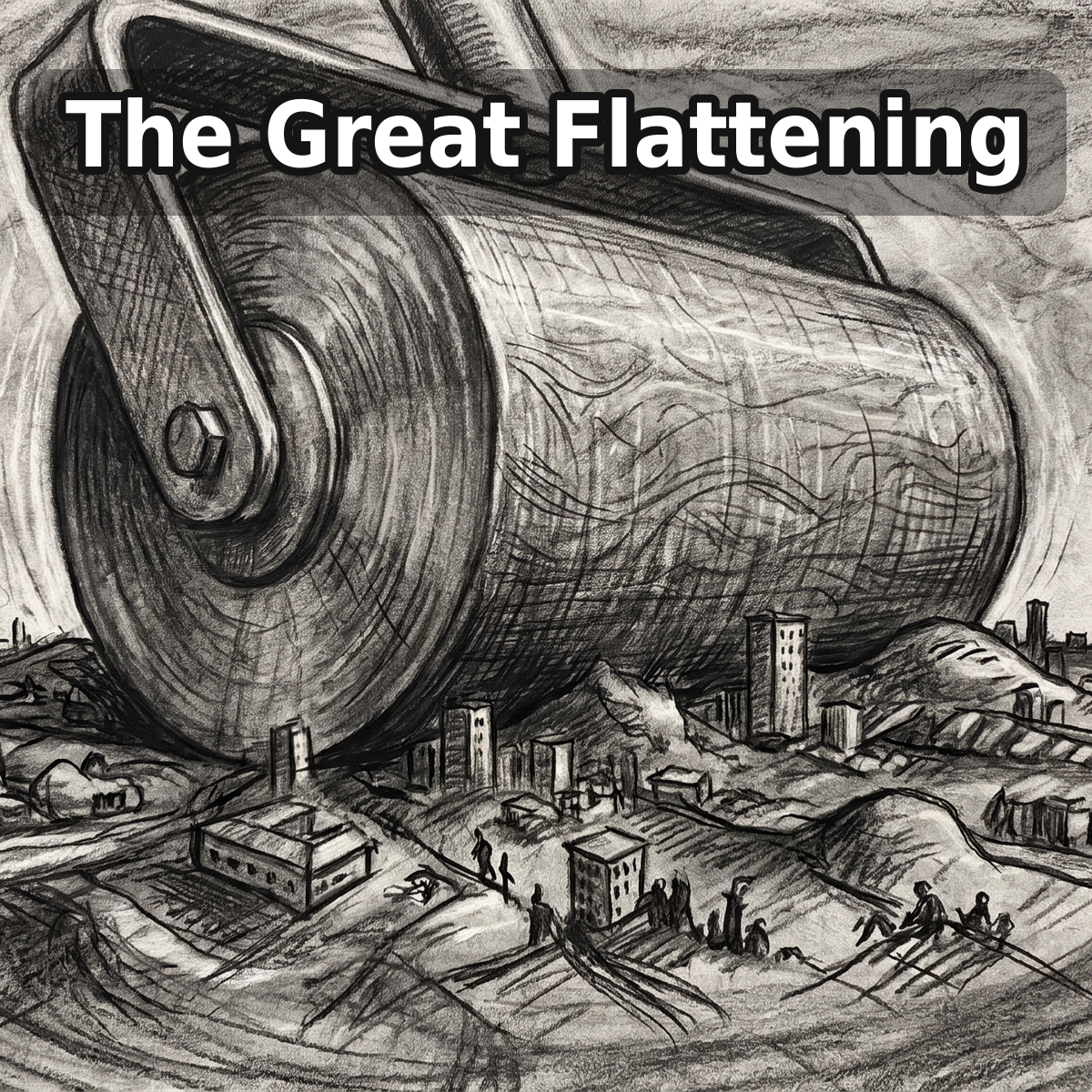
However, there is evidence of one thing that is absolutely happening. I think we can call it the great flattening. AI, used properly, will not change a person’s ideas that much. If people use it carelessly, then it will inject concepts and ideas that are highly common, predictable, and repeatable. Most people that use AI on a regular basis have learned to prompt around that phenomenon, but there is one thing that is difficult to avoid: flattening.
A recent study in Nature Human Behaviour (DOI: 10.1038/s41562-026-02549-7) suggests that the widespread use of AI writing assistants, particularly since the advent of tools like ChatGPT, is leading to a concerning "voice flattening" in personal identity. This research, which analyzed over 880,000 texts, found that while AI-assisted rewriting maintains the original meaning, it significantly reduces linguistic diversity. The implication is profound: if our words become generic, our thinking may follow suit, and the unique traits we project through our writing may be biased by AI’s influence, blurring the very essence of our personal identity.
That is the real present danger in my opinion. Your words, although technically correct and your ideas unique and creative, your voice becomes lost. This is hard to grapple with because heavy AI use makes you realize that your grammar, sentence structure, and the way you represent topics may not be as good as they could be. So your temptation is to lean on AI heavily, but be wary, because as you do so you are indeed removing the soul from the work. I have been building a writing application for the last year. Slowly, bit by bit, I have been working on how to create a system that improves the speed and efficacy of expression. The one thing I have been careful about is replacing the act of writing itself. Mostly because I believe strongly in the therapeutic effects of writing, but now I am even more convinced that my voice, my personality, my expression, the way I relate experience is valuable in and of itself.
So as you start to use AI more in your life, you may want to consider the impact it has on who you are and how you express yourself. As with all things, if you are prescriptive and deliberate, you will find these tools powerful but constrained. If you go about this mindlessly and with no consideration of the impact, you may indeed find yourself sounding like a robot and one that has no soul. Humans are really good detectors of this, even better than a machine is. The famous Turing test has been beaten by many of the modern AI models. They are able to successfully "fool" people into thinking they are human. That is all well and good until we all start sounding like the same human, and that is not an attractive proposition.
So my recommendation? Use AI, but be deliberate and be sure to maintain your voice. We love you because of your uniqueness; please keep that intact above all else.