I have often pondered what art is. Creative outlets are just as much a part of human existence as eating or sleeping. Since the beginning of time, we have been expressing ourselves or trying to understand ourselves through artistic expression. Does form follow function, or does function follow form? The age-old debate. I am looking at two tape measures sitting on my desk. I was working on a project and for some reason collected two tape measures. One of them is ugly, bulky, but highly functional. The numbers are easy to read, the action is clean, and it even has a belt clip, if you were so inclined to attach it to your belt. On close inspection, it has many features captured that you may not notice on casual use. It has a place to nail the end of it into place so that you can measure a longer distance. It has glow-in-the-dark numbers, and it has various markers for convenience depending on what you are working on. This is the epitome of form following function.
On the other hand, the other tape measure, the one that I actually used, is a much simpler device. It is smaller, made out of a brushed metal, and just looks cool. I like to hold it because it is rather fun to fiddle with. Not only is it a decent tape measure, but it also serves as a fidget spinner. This tape measure serves its purpose. I can measure things, well, at least most things. It is shorter, has fewer features, but it looks like a retro tool from the early 1900s and has a die-cast look that is attractive. This tape measure is a representation of function following form. You can tell that the aim of the manufacturer was to produce a tape measure that you would not mind carrying in your satchel. That choice of word was deliberate because the wielder of the satchel would probably care about such a matter.
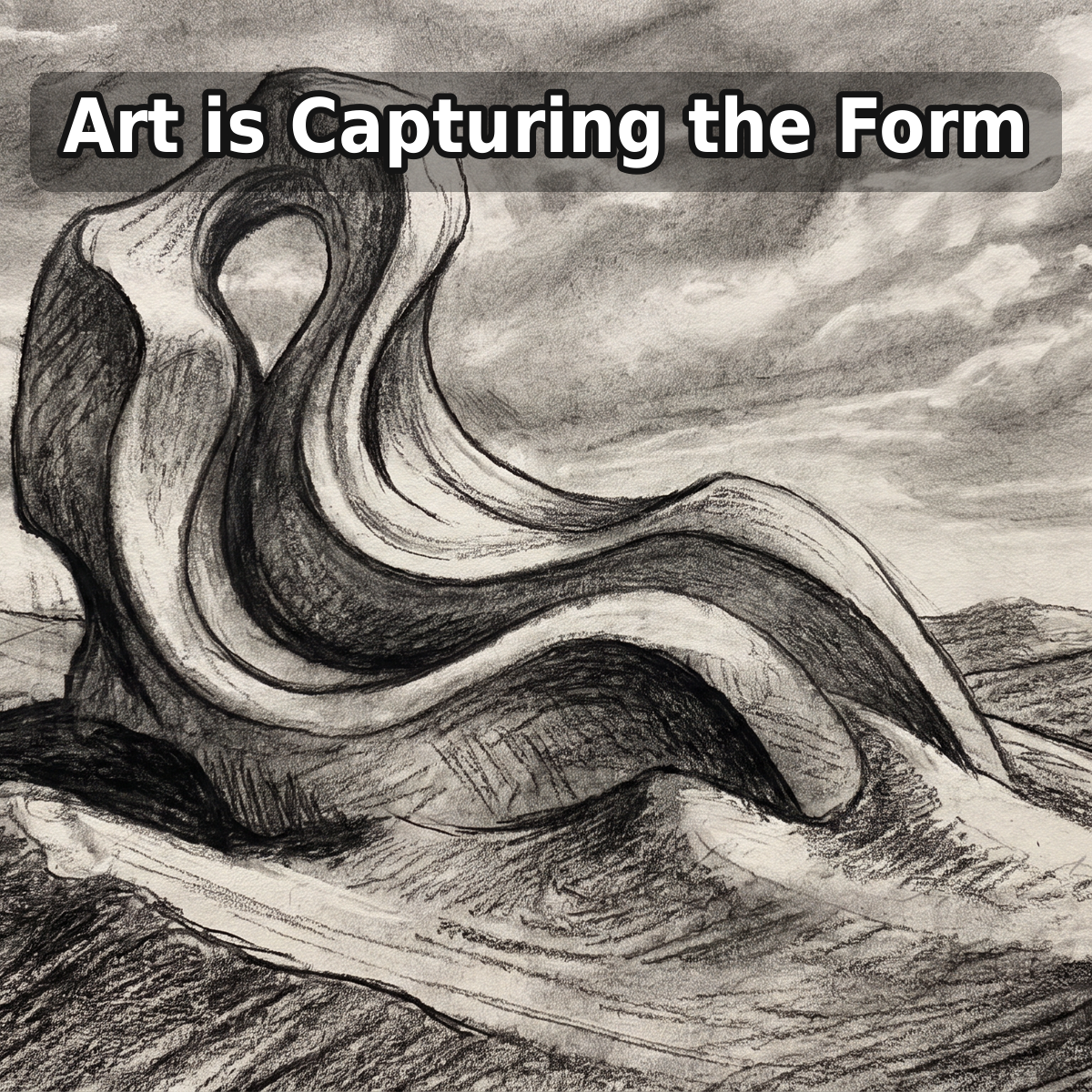
So you might argue that the second tape measure was more art. Then, of course, you would get into an argument with those that believe that art should be, at its very nature, functional. Meaning something is not really artistic unless it serves a function. Not sure I believe that, but I know that camp exists. Well, I got introduced to a new argument, and that is that art does not precede or follow function, but rather captures the form. That is interesting. We all use light switches, and they all have a form, but what if someone truly captured its form? Brought it to life so that you could experience the light switch and instantly understand the connection it has to almost the entire human family. That would definitely be artistic.
In the middle of the New Mexico desert, in 1971, a man named Charles Ross started building what he is now calling the Star Axis. Go to the website at staraxis.org and watch the documentary. He has not finished the project yet. They are saying it will be done in the next year or so. This ambitious project started out with one primary purpose, which has now extended into other areas, and that was to capture the journey of the North Star, or more officially, the star known as Polaris. Humankind has been staring up into the heavens and looking at this star since we took our first steps. It is one of the constants in the heavens, and civilizations have been tracking it through various means for multiple millennia.
A few years ago, I ran a race out in the Nevada desert that went into the night. While running in nearly pitch-black conditions, my headlamp ran out of batteries. While I sat on a rock trying to fiddle with putting new batteries in, I suddenly could start to see better. That is when I looked up and realized the night sky was full of light. I know this, of course, but when you live in a crowded area, the light pollution can sometimes make you forget just how many stars are visible with the naked eye in a dark sky. I sat there for a few minutes and just connected with all my ancestors in a flash of recognition that they had also seen this same night sky. Perhaps that is what Charles Ross is intending to capture with his project.
What is fascinating about his project is that as you walk up these stairs and look up, you can see a circle, and if you are on the correct stair, the star Polaris will actually go around that circle. The reason is the Earth has a wobble, and that wobble follows a highly predictable pattern, and it is slowly shifting. I believe I read somewhere that our North Star might eventually become the star Vega instead because of this persistent and shifting wobble in the Earth’s rotation. So Charles Ross describes this as moving forward yet backward in time as you see the same pattern people might have seen thousands of years ago while you are on a particular step.
So I think I can definitely call this art. Charles Ross is truly capturing the form here. We are all surrounded by light, and we all have this one constant to stare up at each night. Just like the common light switch that binds us all, so too are we all staring up at the heavens and seeing the fixed position of the North Star, but of course, with a little bit of wobble thrown in just to keep us guessing.