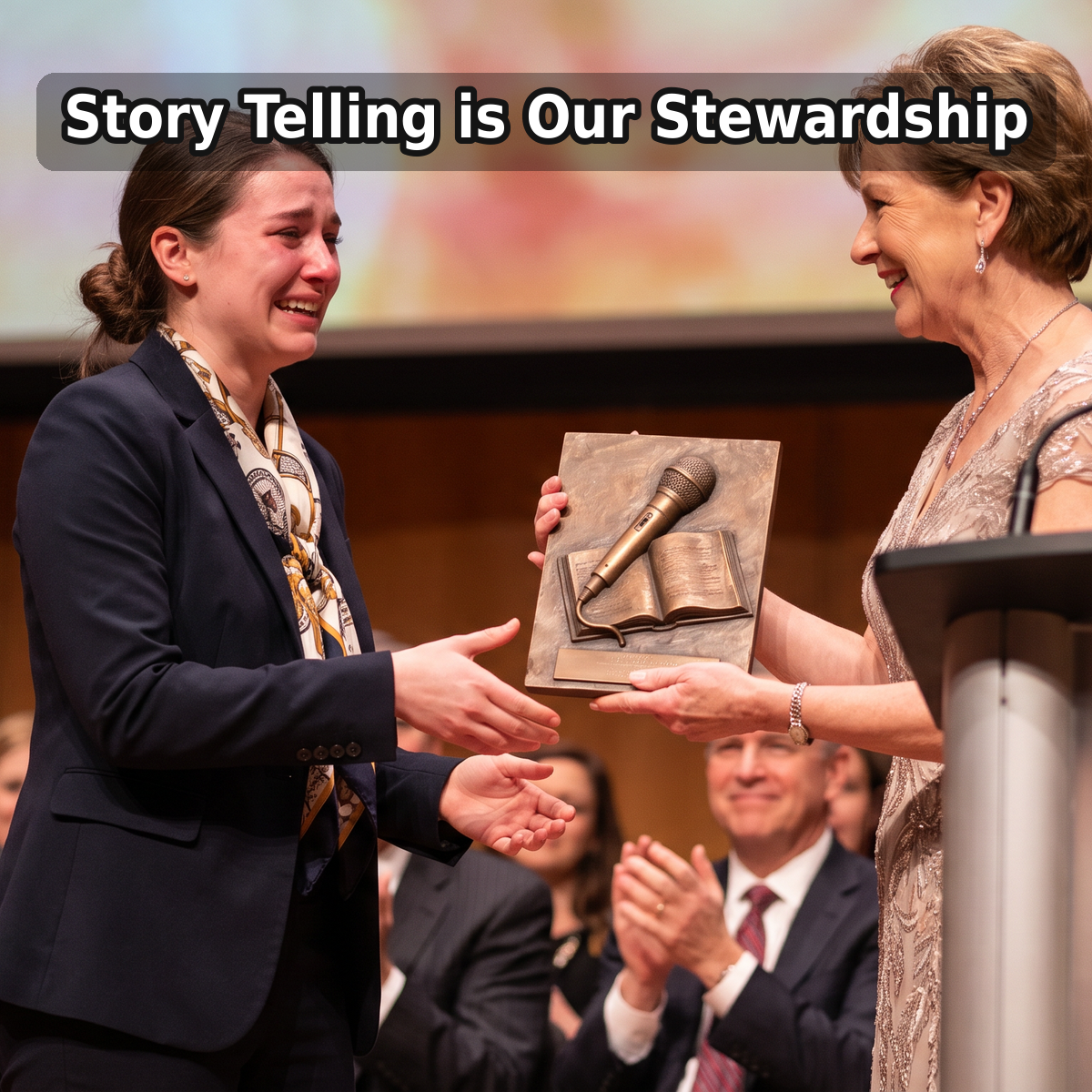
I watched my daughter receive an award yesterday, one she earned through years of hard work. What struck me was how surprised she seemed by it. From her perspective, she had not done anything extraordinary. But that was precisely the point. She won because of the last three years of effort, not because of something she had done that day.
The lesson was simple: perseverance pays off.
My family knows this lesson well. Growing up, I heard story after story about family members who kept going when things were difficult, uncertain, or simply taking longer than expected. As I watched my daughter receive that award, some of those stories came back to me. And it occurred to me that making sure the next few generations know them is now partly my responsibility.
I have come to believe that one of our primary responsibilities is to tell our story.
Not because our lives are necessarily remarkable, but because experience has value only if some portion of it survives us. We spend our lives learning things slowly and often painfully, and then too easily allow those lessons to disappear when we do.
Human progress depends on preventing that loss.
We understand this instinctively in science and technology. An engineer does not begin by rediscovering electricity, and a physician does not start medical knowledge over with each new generation. We record what has been learned so the next person can begin farther down the road.
But much of what matters most in life cannot be handed down as a formula.
How do you teach someone what betrayal feels like, or when loyalty has become foolishness? How do you explain the difference between perseverance and stubbornness, between ambition and greed, or between a difficult season and a reason to quit?
Advice rarely carries enough weight.
A story does.
“Keep going” is advice. The story of a great-grandfather who lost nearly everything, started over, and eventually rebuilt his life is something different. It gives perseverance shape. It places the principle inside a human life, with fear, uncertainty, mistakes, and consequences attached.
For a moment, another person gets to borrow someone else’s experience without having to pay the full price for it themselves.
Perhaps that is why human beings have always told stories. Long before books, databases, and cloud storage, people preserved what mattered around fires and dinner tables. Families repeated stories. Religions preserved them in scripture. Communities carried them forward through songs, legends, and traditions.
We think of storytelling as entertainment, but it may also be one of humanity’s oldest forms of storage.
The tragedy is how quickly a family can lose its accumulated knowledge. A grandchild may know that his grandfather owned a business but never hear that he nearly lost it twice. A granddaughter may know that her grandmother raised five children but never know about the years when money was scarce and she was frightened they would not make it.
The facts remain, but the wisdom disappears.
Then the next generation encounters hardship and believes it is something entirely new. They think they are the first person in the family to fail, to doubt, to struggle financially, or to discover that life has not unfolded according to plan.
Stories remind us that hardship has a lineage, and so does resilience.
I would even dare to say that behind most strong families there is some tradition of storytelling. It may be a grandmother who refuses to let anyone forget where the family came from, a father who tells the same story every Thanksgiving, or a box of letters someone had the good sense not to throw away.
Over time, those stories become more than memories. They become identity.
This is who we are. This is what we have survived. This is what we learned. This is what mattered enough that we decided not to forget it.
The purpose is not to convince our descendants that we were extraordinary. It is to give them a head start.
Our children should know some of the things we learned too late. Our grandchildren should know the stories that taught us what perseverance, courage, faith, failure, and recovery actually look like.
Yesterday, my daughter received an award because years of quiet effort finally became visible.
She may remember the award.
I want her to remember the larger story.
And I want her children to know it too.