One of my favorite theorists is that of Kenneth Burke. Placing him in any particular category is challenging, as his writings crossed many boundaries. One of his books, which shares a place of honor on my bookshelf, is “Language as Symbolic Action.” He wrote this in 1966, and although it was met with little fanfare, many disciplines started to pick up his ideas as they were powerful. The particular concept I am focused on for this writing is that symbols do much more than convey reality; they can also serve to shape and define the way we perceive reality.
Burke famously said humans were “symbol-using” and “symbol-misusing” animals. He offered that what separated our species from all other animal life was our ability to conceive of what is not there and develop systems of hierarchy to represent this concept, which would propel us to create symbols to convey meaning. Through this act, we created language, and through the development of language, we would have the ability and capacity for significantly improved critical thought. Thus, in the controversial style of an existentialist, Burke would claim that in the case of humans, language preceded thought.
Believe this or not; there is certainly some credence to the idea. We cannot really describe, explain, or even pass down concepts to the next generation with our representative language. Additionally, certain cultures are more advanced in particular areas, not because they are less intelligent than any other human, but because their language is more capable of complexity. All of this brings me to the symbol of the fish.
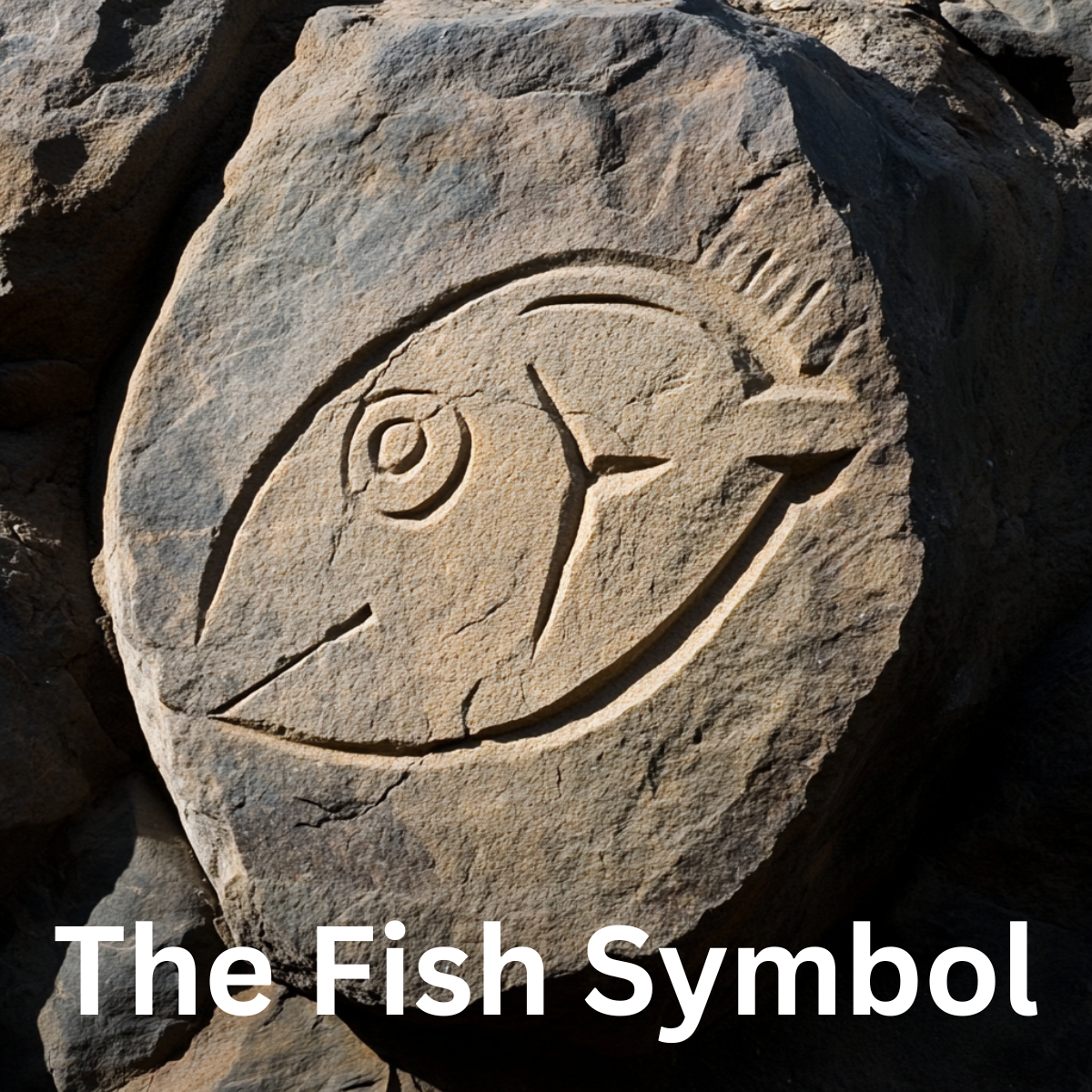
The fish symbol is indeed complex. From the Christian Ichthys that you see as bumper stickers on cars to the fish symbol in ancient Greek and Roman literature we find evidence of this representation everywhere in human history. You can imagine why. A life sustaining creature that can be pulled out of mysterious depths that has seemingly endless abundance would play a major role in the lives of many of our predecessors.
I often think of symbols to guide certain times of my life. Rather then explaining and reexplainign what I am up to, to myself, I can use this symbol to capture all the intended meaning. Instead of saying that I am willing to be adaptable to change, that I am seeking a new awakening or a rebirth so that I can find even greater abundance; I can instead think of a fish. You see throughout human history, the fish has represented exactly this.
We can theorize on why. The fish symbolizes something hidden, some new thing we can discovery that is mysterious to us. Just as the fish hides under the depths to be discovered, so can our quest for new knowledge and wisdom. Fish are considered to be abundant, and always available. So we too can view our efforts as being headed toward greater prosperity and abundance. The fish is always navigating unseen currents which metaphorically represents adaptability, flexibility and an otherwise capable willingness to change and adapt to new circumstances.
So when we seek to catch a fish, we are seeking hidden knowledge, new spiritual revelation and hoping to achieve personal transformation. The act of catching this fish is one of fulfilling an internal desire, a quest for enlightenment. When you use the symbol of the fish, you are not just reflecting an image that represents a creature that swims our oceans and streams, rather, we are influencing ourselves to change. In line with Mr. Burke, the symbol changes our perception of the world and carry persuasive power.
So today, as I put a small fish symbol on the monitor in front of me, I am persuading myself to transform.