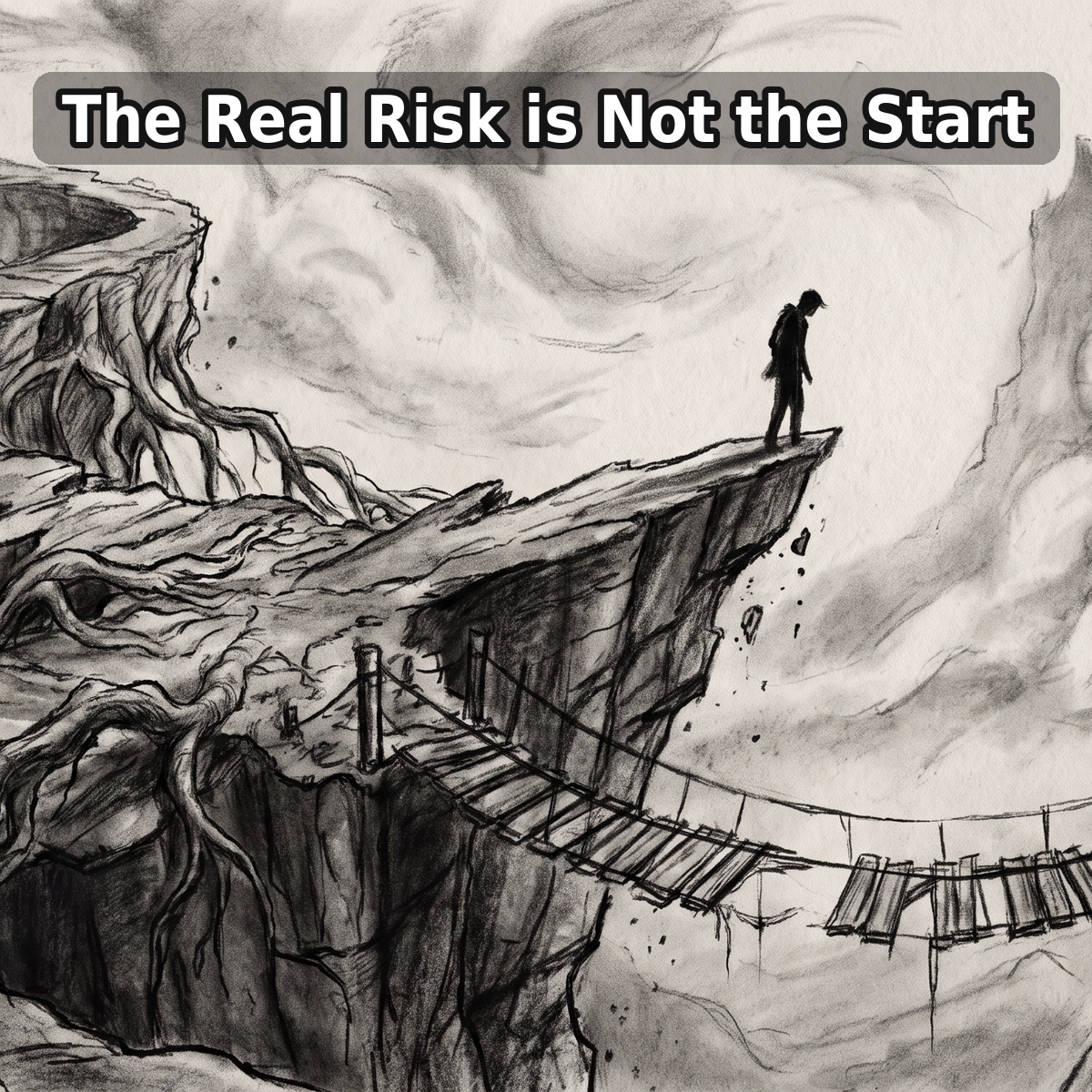
This is one of the most difficult and soul-revealing concepts I’ve had to struggle through. For a long time, I believed that in order to commit to something, I had to be perfect—or at least complete in my commitment—before diving in. This mindset has applied to almost every area of my life: eating, exercise, career, religion—it doesn’t matter. All my activities have been subject to this issue. If I wasn’t perfect, I wouldn’t start. And if I didn’t remain perfect, I would quit.
Some call this perfectionism, but I think it’s more complicated than that. People who struggle with this tend to have a strong sense of how the world should be. They can see the ideal. That’s actually an admirable trait, one that’s often sought after in leaders—the ability to see the forest for the trees, to know where we’re headed even when things are dark or confusing.
But the downside is paralysis. Instead of just doing, we sit and stew in what’s missing. We delay, we analyze, and we often never take the first step.
Practical, roll-up-your-sleeves kind of people often don’t understand this way of thinking—and to be fair, it can be frustrating. But ironically, when things fall apart and the road forward becomes unclear, even the most pragmatic people look to these visionary types for direction. That’s the paradox. The ones who can’t seem to get moving in normal times are often the first to act in a crisis—and they usually come up with the most effective plans under pressure.
Why? Because they’ve already considered all the possibilities. They’ve been overthinking everything all the time. So when something hits, they’re just acting on instinct—instinct sharpened by endless hours of analysis. They can make intuitive leaps that others can’t because they’ve already mentally lived through a hundred different scenarios.
So, in a strange way, you don’t really want these perfectionists around when speed and execution are all that matter—but you do want them around in a crisis, because that’s when they shine.
The problem, of course, is that we’re not always in crisis. And so, most of the time, this tendency to overthink and over-perfect becomes a liability—not just to others, but to ourselves.
I know this well. I am one of these people.
It’s taken me a long time to break free of the belief that everything has to be perfect before I begin. I had to teach myself to jump in and try—over and over again—with repeating consistency, in order to overcome my deeply ingrained impulse to wait until everything is just right.
For most of my life, I had this intense desire to get everything in order before I would execute. I became an expert at developing complex systems—systems I would use once or twice before getting discouraged and moving on to the next idea. I have a graveyard of meticulously designed plans that could have changed the world—but they were never executed. I spent all my time and energy building the perfect system, and none of it actually doing the work.
Fixing this took years, and I’m still a work in progress. But I’ve learned this: consistency applied to an imperfect system will always outperform a perfect system that never launches.
It’s the SpaceX versus NASA story. Do you over-engineer every last detail, or do you launch and iterate? SpaceX isn’t reckless, but the comparison is valid. You can overthink your way into stagnation, or you can get moving and figure things out as you go.
The right way to pursue perfection is not before you start—but after a lifetime of dedication and purpose.
The more I grow, the more I realize that the best solutions—the most profound breakthroughs—aren’t built in advance. They’re discovered accidentally while walking the long, faithful path of consistency and focus.
So if you’re waiting to be perfect before you start, stop waiting. Dive in, make a mess, fall short, and keep going. The goal isn’t to be flawless—it’s to be faithful. Faithful to the work. Faithful to the process. That’s the only way anything worth doing ever gets done.