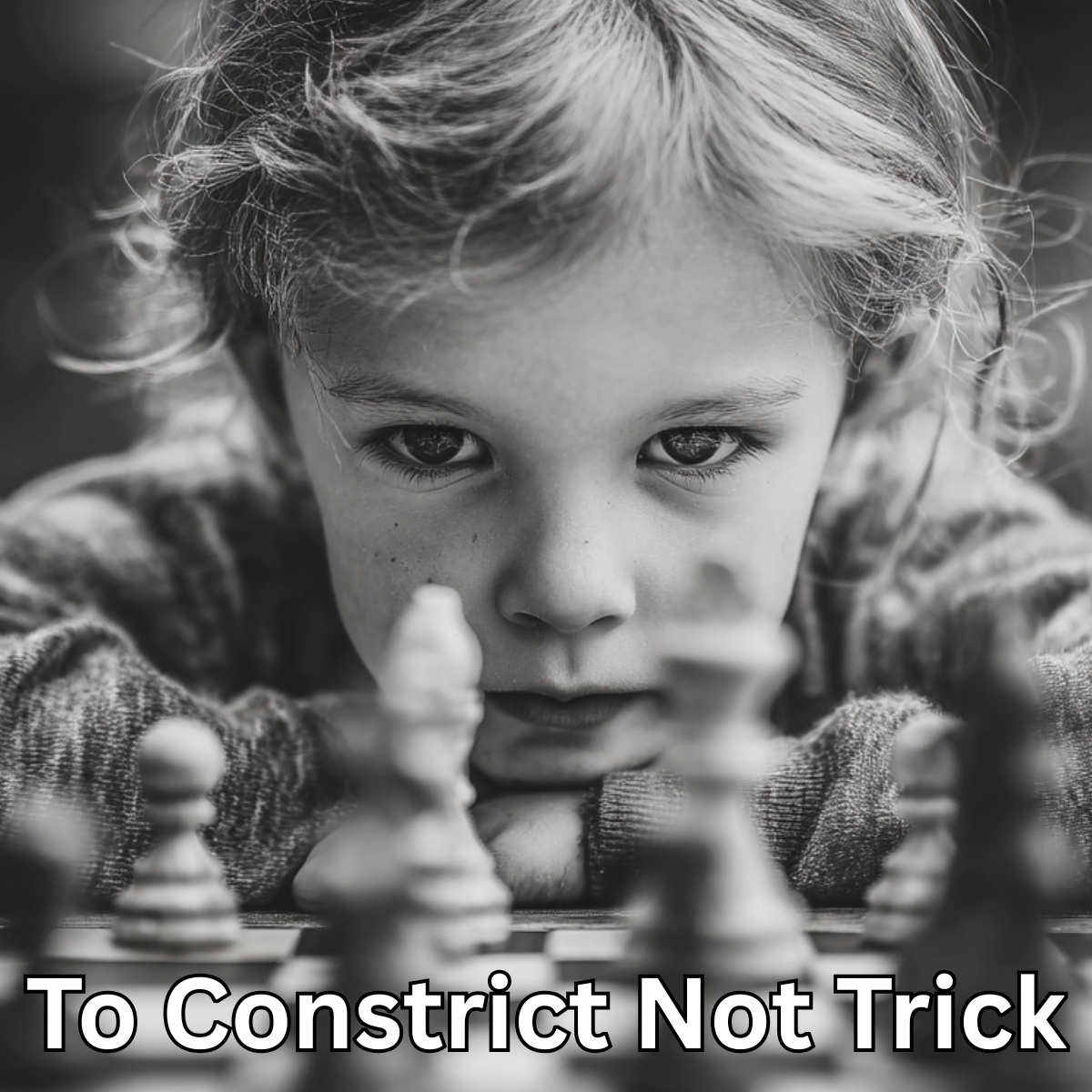
Many people think of chess by remembering the time when a wild-eyed child challenged them to a game at a holiday party. Within a few moves, the child sprung a trap, catching them off guard with a quick checkmate. They leave the experience shaking their heads, marveling at the child’s brilliance, and concluding that winning chess involves elaborate calculations and clever tricks. Consequently, one of the greatest strategic games is reduced to mere parlor tricks in the average person’s perception.
What most people never realize is that success in chess depends not on memorizing tricks but rather on the ability to constrict one’s opponent. Victory is achieved by gradually restricting the space and options available to the opponent until they reach a state known as zugzwang, where any legal move results in a disadvantage or loss. To simplify, the goal is to effectively narrow down the opponent’s choices by systematically limiting their available moves.
This concept is not exclusive to chess; it is equally applicable to many areas of life. The Karen Read trial concluded recently with a split decision, ultimately resulting in an acquittal on the more serious charges. Watching the cross-examinations by the renowned defense attorney Alan Jackson, I noted that his strategy resembled that of a skilled chess player. He began by presenting the witness with a wide field of possibilities and methodically removed options until the witness faced unappealing choices—either admitting they were lying, mistaken, or ignorant. In one notable cross-examination, witness Jen McCabe realized too late the predicament she was in, forced either to admit previous testimony as truthful or to recant it to make her current testimony seem credible. Defense attorneys must relish when witnesses scramble in these moments, either feigning forgetfulness or offering explanations that inevitably damage their credibility.
Most people are neither professional chess players nor top-notch defense attorneys involved in high-profile trials. Yet, many of us engage regularly in negotiations, contract disputes, sales meetings, or the all-too-common debate over “what we are going to watch tonight.” My family used to enjoy game nights, playing popular board games around the kitchen table. Though that tradition eventually faded, at its peak, my wife accused me of cheating. She claimed I expertly bent the rules, executed sleight-of-hand tricks, and employed Jedi mind tricks to sway outcomes in my favor, nearly leading us to marriage counseling after a particularly intense game of Monopoly. Nowadays, I passively observe, win or lose. In my youth, however, I was simply playing chess—slowly reducing my opponent’s options until they had no choice but to concede or pay. Was it cheating? Not in my mind; it was merely strategic constriction. Was it the best strategy for marital happiness? Probably not.
Constricting is ultimately the only effective strategy when facing equally competent opponents. Without obvious weaknesses to exploit, you must play the long game, gradually securing strategic areas to limit your opponent’s maneuverability. This principle holds true in almost every sport, certainly in business, and sometimes in relationships. As cold and calculated as this approach may sound, I don’t mean it negatively; it simply reflects how relationships and negotiations naturally evolve.
Returning to marriage, as newlyweds, vast areas of our lives were unexplored territory. As we grew together, we began staking claims on various aspects. My wife quickly claimed the kitchen, and I wisely backed down. I initially resisted her interior decorating choices but ultimately conceded. Over time, each of us made strategic “moves” until we reached a balance, occasionally painful but mostly peaceful and harmonious. Fairy tale endings rarely reveal the complex reality of “happily ever after.”
I mention this not to suggest that relationships are battlegrounds but to highlight that every relationship involves negotiating space. Whether working, living, or simply existing with others, there’s always subtle negotiation occurring. It need not be adversarial, but the negotiation happens nonetheless.
In conclusion, when dealing with adversaries, competitors, or companies from whom you’re aiming to take market share, constriction is the most reliable strategy. Tricks and traps may offer short-term gains but rarely withstand sustained scrutiny. Like chess, a failed trap leaves you exposed and disadvantaged. All moves should contribute to the broader strategy—winning the battle for space. When confronting a larger opponent, consider how to constrict their options so each move they make ultimately benefits you. This strategic mindset is essential in any serious competition. Ultimately, success requires a strategy of constriction, not deception.