My wife and her friends are having a summit today. To help one of their dear friends figure out a way to improve her prospects of finding a partner to date and hopefully get married to. I was casually listening in on the conversation every once in a while when I went into steal snacks from the spread my wife put out for everyone. Although there were many opinions being expressed, the one universal theme that got my attention was this:
If you want to meet someone who could fundamentally change your life, you may first have to change the environments in which you live your life.
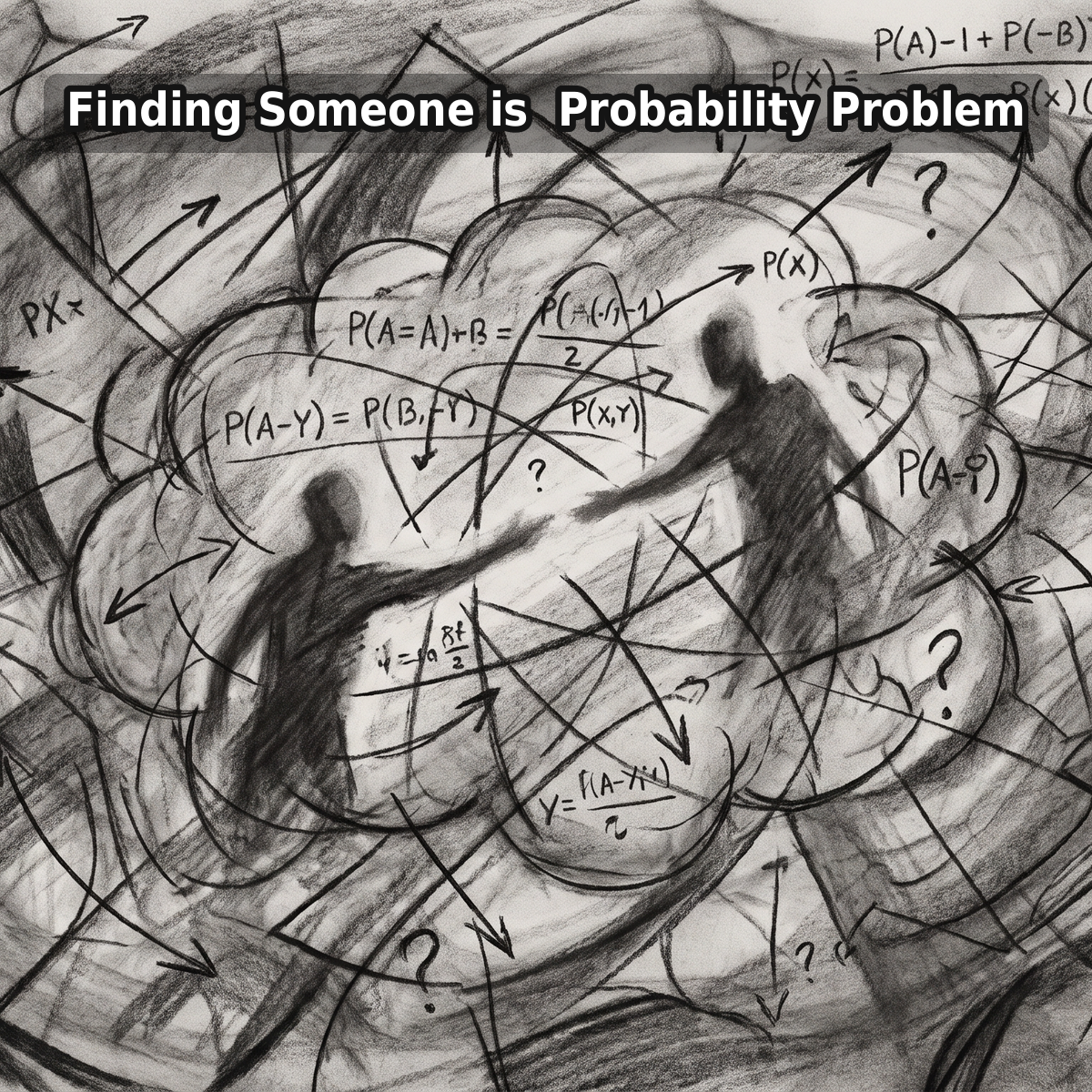
Why? Because dating is partly a relationship problem, but before a relationship exists, it is a probability problem. What occurred to me is that this same problem exists when attempting to build any new relationship. New investors, new friends, new customers, and new and inspiring people who could change your life.
If you go to work, interact with the same professional circle, go home, spend time with the same friends, and stay glued to your phone, interacting with superficial connections on social media all the time, then you are largely drawing from the same social universe over and over again. Nothing is necessarily wrong with that universe. It just has a limited supply of new people.
Changing the environment changes several things simultaneously.
First, it changes who is available to meet. Every environment has its own population. A conference attracts a different group of people than your office. A volunteer organization exposes you to people you would probably never encounter at your neighborhood restaurant. A running club, church group, professional association, class, chess club, or community event each creates a different pool of potential relationships. When you intentionally enter new environments, you are not simply hoping to meet someone new. You are mathematically increasing the number and variety of people who can enter your life.
Second, repeated exposure matters. Most meaningful relationships do not begin with some spectacular first encounter. They develop through familiarity. You see someone once. Then again. Eventually you have a conversation. Later you discover a shared interest. Trust begins to form almost invisibly through a series of small interactions. This is why environments that you participate in consistently can be so powerful. The goal is not simply to go somewhere new once. It is to become part of new places where the same people have an opportunity to see you, know you, and eventually trust you.
Third, the environment creates many new weak ties. Weak ties are the people we know casually—the person from the running club, someone we met at a conference, a friend of a friend, the parent we see at an event, or the person we occasionally talk with at a coffee shop. These relationships may seem insignificant, but they dramatically expand our social universe. Every new person potentially connects us to dozens or hundreds of people we do not yet know. Your next customer may not be the person you meet at the event. It may be someone they introduce you to. Your next investor may be two introductions away. Your future spouse may be the friend of someone you barely know today. Weak ties create bridges into entirely new networks.
And that may be the larger lesson hidden inside my wife’s summit.
Sometimes we spend enormous amounts of energy trying to improve the outcome while leaving the environment that produces it completely unchanged. We work harder at networking with the same people. We scroll through more profiles. We send more messages. We hope that somehow something different will emerge from essentially the same inputs. But occasionally the most powerful move is much simpler.
Change the inputs.
Go somewhere you normally wouldn’t go. Join something. Volunteer. Take a class. Attend the conference. Accept the invitation. Sit at a different table. Talk to someone you don’t already know. Become a regular somewhere new. You cannot control whether the next person you meet becomes a spouse, a friend, an investor, a mentor, or a customer. But you can dramatically influence the likelihood of meeting someone new.
And sometimes changing your life begins with something as simple as changing where you spend it.