Have you ever stopped to consider how you formed a particular opinion? This could be a viewpoint about conditions in an area of the world you have never visited, a conspiracy theory that you believe or do not believe, a religion you have dismissed, or a political stance that you have decided to take. What formed this opinion? The next question to consider is: How strongly do I believe this? Could anything change my mind?
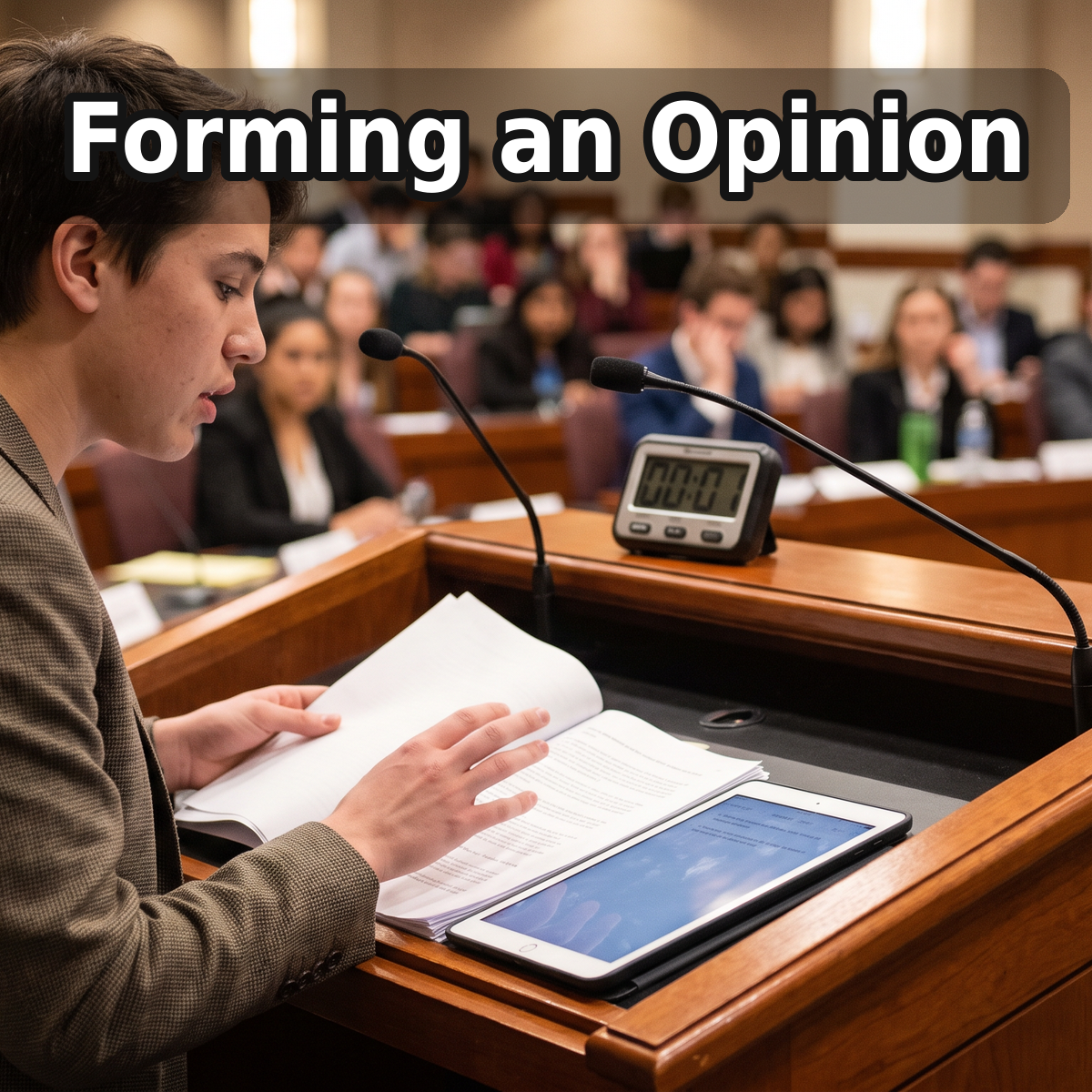
Growing up, I was involved in speech and debate, which was called Forensics at the time. I think that word has become associated with crime scene investigation, so now we just say debate. Although I like referring to it as forensics because that was truly what it was. We were immersed in the consideration and effectiveness of claims and how those could be backed up by various sources of evidence. We would frequently borrow from different fields, especially the legal field, to bring stronger arguments to defeat various "expert" opinions.
Debate is notorious for making causal link chains that lead to some serious impact. When I was younger, the favorite topic was nuclear war. Everything would lead to a nuclear war if you kept linking the evidence together in a way that demonstrated some causality. Debate teams were arguing that all kinds of things would lead to nuclear war. From overharvesting Amazon jungles to underfunding public education, there was always a way to link these to social unrest, trade imbalances, and therefore global thermonuclear war. That then became a global ice age. My children were on a debate team in college, and their great calamity that everything linked to was global warming.
However, just having a causal link was not strong evidence. Debate would often digress into a speed round to determine who could read the most evidence as fast as possible. They called this "spreading," the ability to just dump a bunch of evidence leading toward one of these terrible potential outcomes. So you either had to become really adept at reading evidence briefs, or you had to learn to tear apart arguments at their seams by attacking evidence quality. I chose the latter.
As a consequence, I have always had in the back of my mind what causes me to form an opinion. Psychologists seem to distinguish between the strength of an opinion and the strength of the basis for an opinion, which are not the same thing. Someone can be extremely certain of something, with almost no support for that opinion. The word here would be epistemic. You may have a strong opinion, but your epistemic foundation could be very weak.
So what is this epistemic foundation? If we were in a courtroom and you tried to bring in evidence to prove your opinion, you would run smack into the necessity of providing a foundation for any evidence to be introduced into the courtroom. You would suddenly find yourself swimming in a sea of evidentiary rules that have been adjudicated for centuries. Many people want to argue a defense of their opinion on the basis of intuition. "It just feels wrong to me," relying on their feelings, instincts, or preferences. This is the weakest foundation for an opinion, and people learn that quickly in a courtroom.
Next might be an appeal to authority. That can be an authority derived from your society, your peers, your tribe, or perhaps just hearsay: "everyone is saying this!" Sometimes this can be stronger, meaning it comes from an authority that people trust, and in that case it will carry more weight, but the fact remains, basing an opinion only on the testimony of others is also a weak epistemic foundation.
Next up is anecdotal. This is from personal experience. I saw this happen myself, or this is what happened to me are difficult arguments to defend against. However, they are just that: individual experience. They may be strong for the particular person, but not strong in terms of formulating a basis for an opinion that others should adopt as well. This is still pretty weak evidence, but stronger than intuition or hearsay. In a courtroom, this would be eyewitness testimony.
Then we get to the higher levels of establishing an epistemic foundation for an opinion. An informed opinion is one in which you have multiple sources, facts, experience, and have done at least some rudimentary analysis. You might say, "I have looked into this, and several sources support it." Higher than an informed opinion is one that you have investigated. This implies that you have done research, your evidence is of high quality and from independent sources, and that you have had competing explanations weighed against your findings. In research circles, this is called being "peer-reviewed."
Finally, the best and strongest epistemic foundation for an opinion would be one that is robust. Meaning that you have strong, convincing evidence, the methods of deriving that evidence are well understood, and you have tested counterevidence. More importantly, you have a strong conclusion, but that conclusion remains revisable, and you know exactly what new evidence would change your mind.
Putting this all together. If you have a weak foundation and express high confidence in your opinion, then you are being dogmatic. If you have a strong foundation and high confidence, then that can be considered a well-supported conviction. There is a big difference between these two. If you have low confidence and a weak foundation, then you are just speculating. This is ok, as long as you are open about what you are trying to do. If you have low confidence with a strong foundation, then you are just being careful or perhaps too nice.
We tend to talk about opinions as though they are all epistemically equivalent. This is just not true, and dangerous. You have heard the popular phrase: opinions are like a$$holes; everyone has one. This is true, but where that phrase stops short in rhetorical critique is that everyone has an opinion, and you can indeed judge the basis on which that opinion was formed.