Danced on this floor before, but in the art of improving life I think part of the canvas is breaking things down to subsystems. Best if done visually. This morning, I used a drawing tool to draw a few bubbles around a stick figure representation of myself. Old School UML Use Case Style. The stick figure represented me as the future ultra marathon athlete. I asked myself, what subsystems would I need to be really good at to get to that state?
That was an interesting question. At first I thought it would be easy! Not so fast!
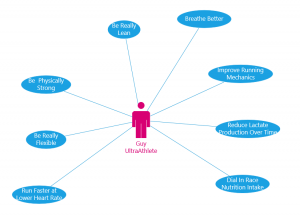
As it turns out there are a lot of subsystems in becoming a solid ultra running athlete. My problem is that I am not dealing with anyone individually in a prescriptive manner. Rather, I am generally moving in the direction, with some general guidelines, but not specific focus on anyone given subsystem.
Sound too technical? I think not. Ask yourself why am I not improving? I am trying to get somewhere but I am not getting better, why? You will discover that it is mostly likely not any one given thing. It is likely multiple things compounding together to produce your result.
So instead, you need to evaluate your ambition in a series of subsystems. Taking my example, during my run I realized that my breathing was becoming labored and more difficult after 22 miles. Lots of reasons for that, but I was definitely struggling with getting good deep, oxygen rich air intakes. I started breathing more shallow, and effectively panting at one point. I need to improve this area dramatically. My reaction when things get tough should be to focus on rejuvenating breathing technique. As it turns out this is quite a science. Lots of people have written about how to improve this area. Something that I need targeted focus on.
Targeted focus? What is that? Well, I can for certain say that focus requires a goal, or a metric that one is driving to. If you cannot break your ideal into subsystems, and you cannot measure those subsystems – then you will never achieve the ideal. I imagine that you will know you have a good subsystem identified when you can actually come up with a metric that can be measured. If the subsystem is too nebulous for a metric, then you need to break it down further. For example, how could I possibly measure “Breathe better.”
Well, maybe I can and that is the point. This would require tremendous effort to measure this type of thing. I would have to have a lung capacity test, or a oxygen saturation test done or something. A lot of effort to measure that – but shouldn’t the most effective measures be sort of hard to do? Evaluating a subsystem requires tremendous focused energy on a particular metric that really identifies successful improvement. Then of course you need to actually work on the things that would have the most impact on improving that metric.
How much time to we spend spinning our wheels on “improving” when actually we are just doing everything we can to keep all the wheels spinning, not really improving anything? If I am going to become more flexible, for example, I certainly need to do a lot more then just simply stretching my legs 5 minutes before a run. Actually work on the subsystem, identify a metric and take extraordinary steps to see progress there.
In my example, I have at least 9 of these subsystems to work on to dramatically improve my running. Sure, I just need to run more – important to not overthink things, but I still cannot avoid the reality that the others areas can significantly impact that capability (diet, flexibility, strength, running form, etc).
As you analyze something you are trying to improve upon, you might want to see if you can break it into subsystems. Spend time trying to figure out how to measure it. Then figure out what you would actually do to commit to improving that metric. Chances are you will discover that your idea will require a ton of things to execute on that you were not expecting. No wonder our “ideas” never become reality most the time.
Guy Reams