Reference this image found on this website. 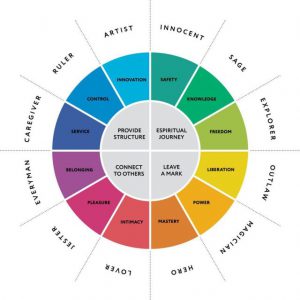
If you are not familiar, Carl Jung was basically the founder of modern psychology. Probably one of the most brilliant minds in the existence of human kind. You could spend a lifetime studying a single paragraph of one of his essays, and many have. Anyway, a cool thing to look and think about is his famous Archetypes of Personality.
There are high level, universal patterns that reside in our collective unconscious as a species. The are inherited if you will. I have even heard theologians reference each of these 12 Archetypes as the splinters of Godliness that is dispersed all through humankind.
What I was thinking about this morning is how to motivate myself when I need motivation. What source can I go to when I just do not want to do something? When I am just tired and do not want to do anything? Habits have saved me many times, but how do I keep the habit AND put in maximum effort? That is going to require motivation. Jungian Archetypes can help you understand those hidden motivations that you can tap into when needed.
Look at the wheel carefully. The colorful strip on the outside is what you might value the most. You should fully expect to immediately identify with multiple of them. You will also notice that some of them are almost in opposition to each other. Welcome to being human! What is the most important to you? Control? Power? (those are separate things). How about freedom, safety, intimacy, belonging? Which of these seems more closely aligned to you?
You can see on the outer ring what the Archetype is that is closely aligned with your trait and/or tendency. Are you a Magician? Are you a Explorer? A Sage? A Ruler, or A Jester? Once you have a visual image of who you associate with, perhaps more than one, then you can go to the inner ring and see what your primary motivators are. According to Jung, human motivators are usually to Leave a Mark, Connect to Others, Provide Structure, and some sort of Spiritual Journey. So what is really your secret motivator?
Funny, I love to be the hero and the outlaw. I have had people tell me how messed up that is. The fact that I like MLK, Ghandi, Jesus and I also really think Tony Soprano, The Godfather, and Caesar Borgia were awesome is just plain jacked up. But is it? According to Jung, my motivator is to leave a mark on society. That is my secret motivator. That is what really drives most of my behavior. It is an internal drum beat that I cannot get a way from. I need to understand that so that I can tap into that motivational source and use it to get myself going when I really need it.
Some of the others apply to me as well, but not nearly as much as the Hero/Outlaw motif. You should spend a minute and figure out what yours are. Also take a moment and examine people around you – you will be shocked to discover what you learn. I tend to really like to surround myself with people that provide structure. No surprise when you look at this diagram.
The more you stare at this wheel, the more you will understand how people think and feel. The more you will understand how you work with them and how you can appeal to them. You can use this knowledge as a tool to motivate yourself and others to action.
Guy Reams