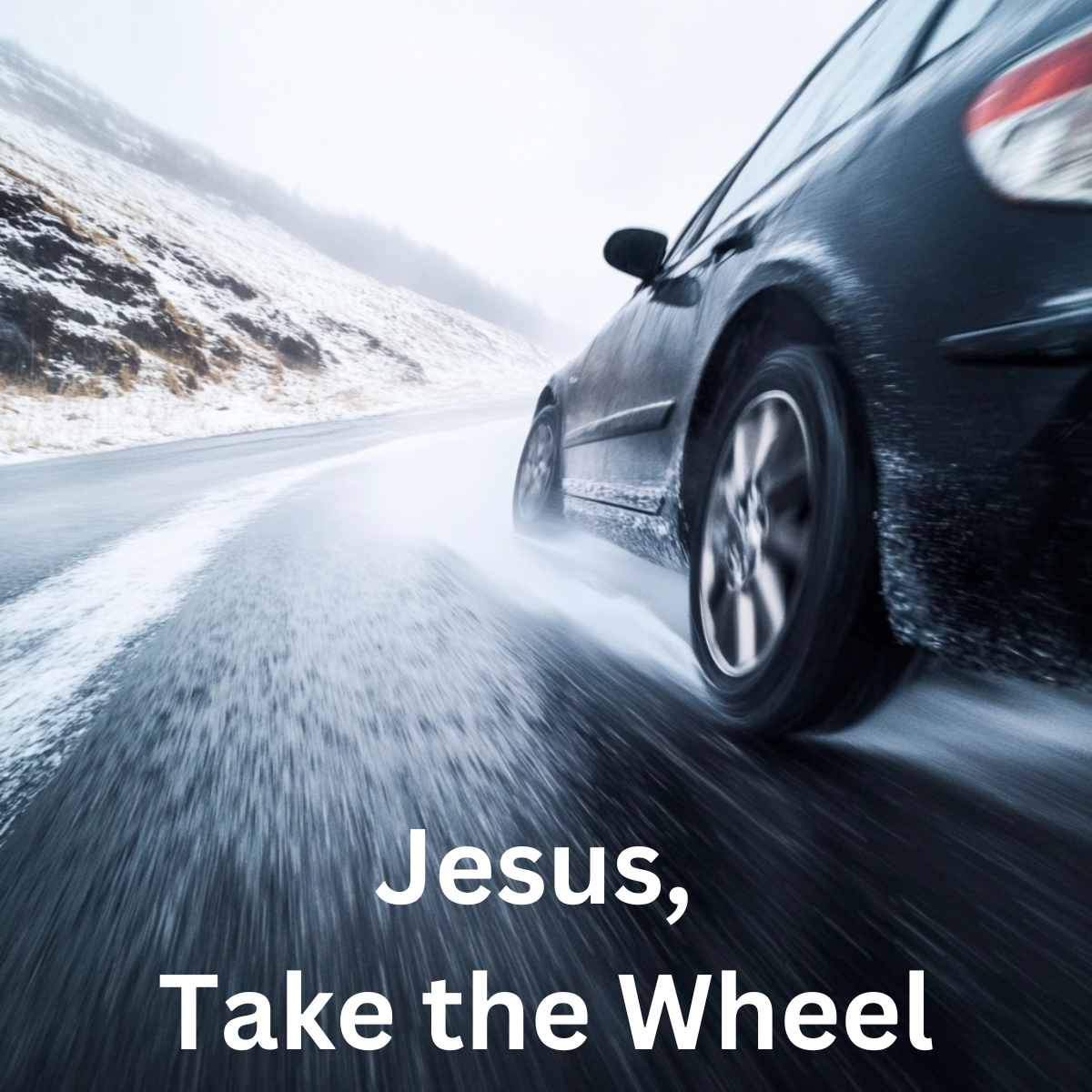
A few years ago, there was a popular song by Carrie Underwood called “Jesus, Take the Wheel.” The story in the song is about a young single mother driving back home with her small child buckled safely in the back seat. She’s at the end of her rope, heading home to seek help from her parents. It’s a dark night, the roads are icy, and in one terrifying moment, her car begins to slide on the ice, spinning toward a ditch. She glances in the rearview mirror and sees her precious child sleeping peacefully. That’s when she throws up her hands and says, “Jesus, take the wheel.”
Now, I recognize there’s a deeper meaning here. It’s not just about a car losing control — it’s about her life spinning out as well. The hope in that moment isn’t just that Jesus will save her from the immediate danger, but that He will also help her through the larger crisis she’s facing.
I used to make fun of this song when I heard it. I thought, How stupid is that — to throw your hands up while sliding on black ice? Maybe God will help you, maybe He won’t, but at least try to save yourself. That was my thought at the time, and the source of my ridicule.
But then one day, a woman pulled up next to me at a red light, and that song was playing on her stereo. Her window was down. She had her head resting in her hand as she waited for the light to turn green. She was crying… and singing along.
I could feel the powerful emotion of the moment. I realized she might be at the end of her rope, and this song — this prayer — was reaching into her soul and giving her just enough hope to keep going.
What is this emotion? This urge to surrender to divine providence? The Psalmist says, “Be still, and know that I am God.” That spiritual act of surrender in times of deep pain, sorrow, fear, or helplessness should not be dismissed as foolish. Something powerful is happening here — and we’d be wise to pause and reflect on it.
When we need it most, should we put our trust in God? Should we let go of our stress over the outcome, our expectations, our illusion of control — and instead trust in something unseen?
Contrary to my initial reaction to Mrs. Underwood’s song, this concept of surrender is not passive resignation. It’s an active and very real spiritual coping mechanism. Through this act, people are releasing their desperate grip on control. We like to believe we have control over everything in our lives, but the truth is — we don’t. And sometimes, it’s only through great difficulty that we come to face that reality.
What do we do when the pressure is so great, the consequences so severe, that we feel crushed under the burden? We need a way to escape that pressure — to transfer the weight from ourselves. How else could we hope for peace? How could we feel comfort when there’s nothing comforting in our circumstances?
And yet… peace is accessible, even when our circumstances don’t change. That’s the beauty and power of knowing you are not alone — of finding comfort from something (or someone) you cannot see.
People who strengthen this bond — this trust — develop something like a superpower. They can function when all hope has faded. They can persevere when facing an insurmountable foe. They can stare down the very jaws of hell and not flinch. That is tangible, practical, and powerful faith.
When all other sources of help fail… why not?
I think that’s what the song is really about.
And for those of you who are Christian, remember — we are not alone in this. Christians do not have a monopoly on this concept. While the stories of Jesus Christ and His apostles are among the most poignant and applicable examples, other faith traditions echo the same truth.
The Gita, for example, is centered on the idea of surrender — a way of life that calls for letting go of ego and recognizing one’s place in the universe. In my brief exploration, I see this everywhere: Buddhism, Taoism, Judaism, even 12-step programs. All of them elevate surrender as central to faith.
It’s worth reflecting on how this applies to us.
Should we lie to ourselves and pretend we are in control, when we’re not? Should we act as if we can withstand every storm — and never feel despair? When the helpers flee, when the people and resources you’ve relied on disappear — what do you have left?
That is when you discover what hope and faith really mean.
If you’ve been in the shadows… if you’ve felt the depth of sorrow… you already know what I’m talking about. And if you haven’t — you’re blessed. But I hope you remember reading this.
Because someday, you might need it. And in that moment, you just might cry out unexpectedly… “Jesus, take the wheel.”
Good one Guy. I have had to ask Jesus to take the wheel many times in my life. There is no shame in connecting with God in our time of need. I have come to the conclusion that God sometimes allows affliction to come into our lives as a gift to help us refocus on our connection with Him. These are some of the best times of my life and growing times as well. I recently heard that a lobster does not shed his outer shell until he is so uncomfortable with it that he has to get out of it. Then a new shell can form. I sometimes think we need to be uncomfortable in order to change. If not, we may never change for the good. Thanks for sharing this article.
Hmm. I am a lobster!