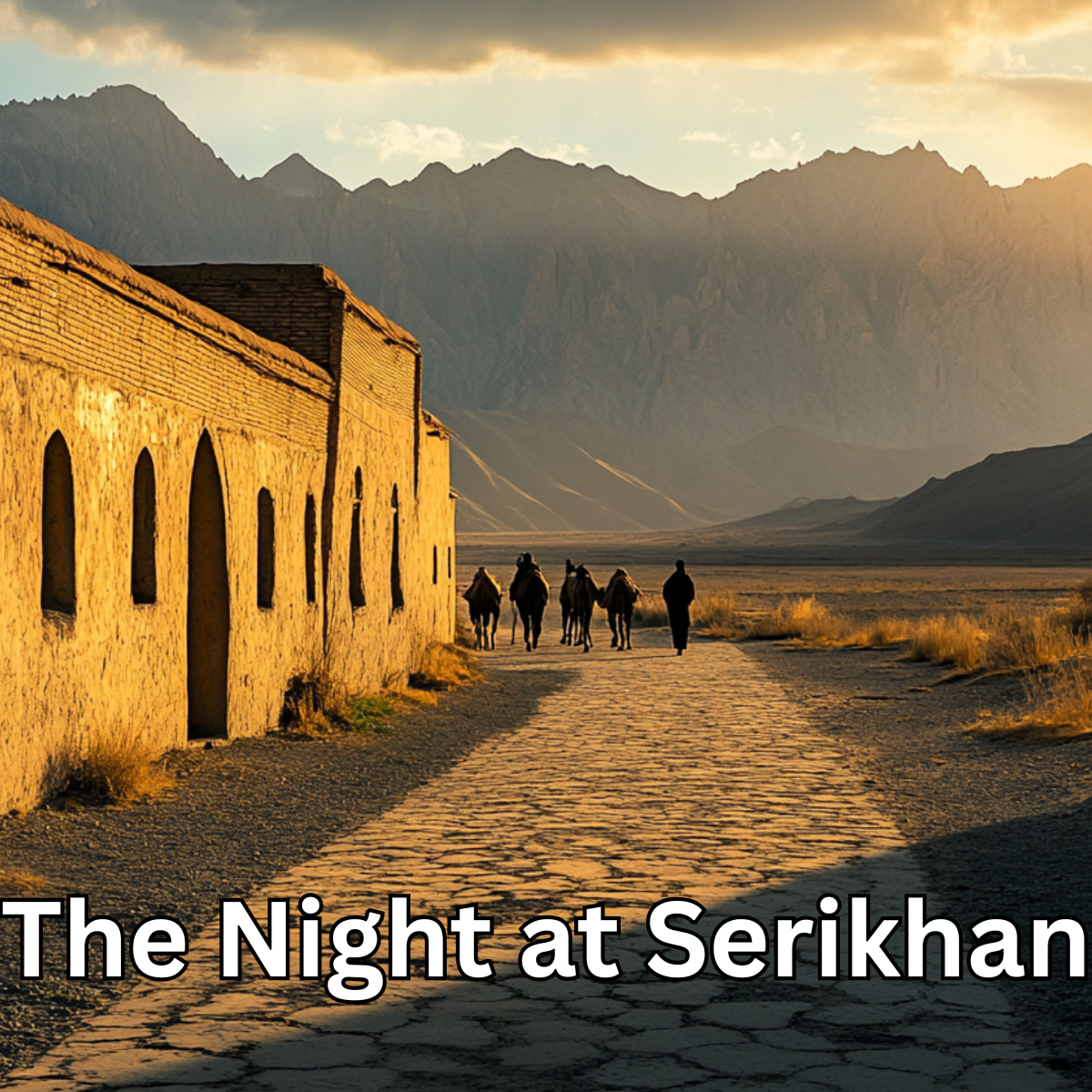
The dust of the Silk Road rose gently with the arrival of the caravan into Serikhan, a modest but well-fortified caravanserai nestled between the Kunlun Mountains and the Taklamakan Desert. As the sun dipped behind jagged peaks, long shadows stretched across the stone courtyard. Travelers, merchants, and scholars dismounted with creaking joints and weary eyes, their camels groaning with relief. Fires were lit. Bread was baked. And as darkness enveloped the ancient refuge, the world condensed into the glow of shared warmth and quiet conversation.
That evening, the stars above Serikhan bore witness to something rare—a gathering not defined by rank, origin, or creed, but by a shared moment in time.
A Persian herbalist spread out her collection of dried roots and ointments, describing in quiet tones the virtues of saffron and the calming properties of sweet basil. A Han dynasty engineer, fascinated, sketched the root shapes with a stick in the dust, sharing in return his knowledge of intricate gears used in early seismographs. A Roman trader, golden stubble on his chin and a weathered face from years at sea and land, unfolded a cloth map—crudely drawn yet mesmerizing—illustrating a world that felt impossibly vast.
A boy from Samarkand, barely of age, played a reed flute with such soul-stirring grace that even the camels fell silent. A woman from the Indus Valley, who had walked weeks carrying textiles dyed in hues unknown to the desert sands, danced slowly in the firelight, her hands moving like flowing water—telling stories of rivers and gods and old prayers spoken under banyan trees.
They laughed in many languages, their words braided by gestures, song, and open hearts. They shared almonds and dates, poured water from clay jugs, and spoke of philosophies, of emperors and fallings stars, of strange customs and familial hopes.
And then, as the sun rose and the sky paled into soft blue, they departed. North, south, east, and west. Never again would they meet. They would forget each other’s names, perhaps, or only remember a laugh, a tune, a drawing in the dust. Yet each would carry something away—an idea, a word, a glimpse into another soul’s world.
For that one night, Serikhan had become something more than shelter. It was a crucible of culture, where knowledge and humanity fused briefly in the vastness of time.
I wrote this because I was thinking about how cultural centers form and why. What makes a place like Serikhan more than a stopover? It’s not the architecture or the walls, but the convergence—the collision—of difference that leads to something meaningful. Trade routes were more than economic arteries; they were lifelines of the human story. They brought us into contact with the unfamiliar, forcing us to reconcile with other ways of seeing the world.
Today, we do not ride camels between empires. Our trade is global, digital, and nearly instant. Yet for all our connectivity, we often lack those quiet, firelit moments of sincere exchange. We know more of each other, but sometimes understand each other less.
So it leaves me wondering:
What is our current caravanserai? Is it a social media platform? A virtual gathering space? Or perhaps something we haven’t yet recognized?
And deeper still—do we need one? Not just to exchange goods or posts or fleeting likes, but to share culture and wisdom in the slow, intentional way our ancestors once did under the stars of the Silk Road.