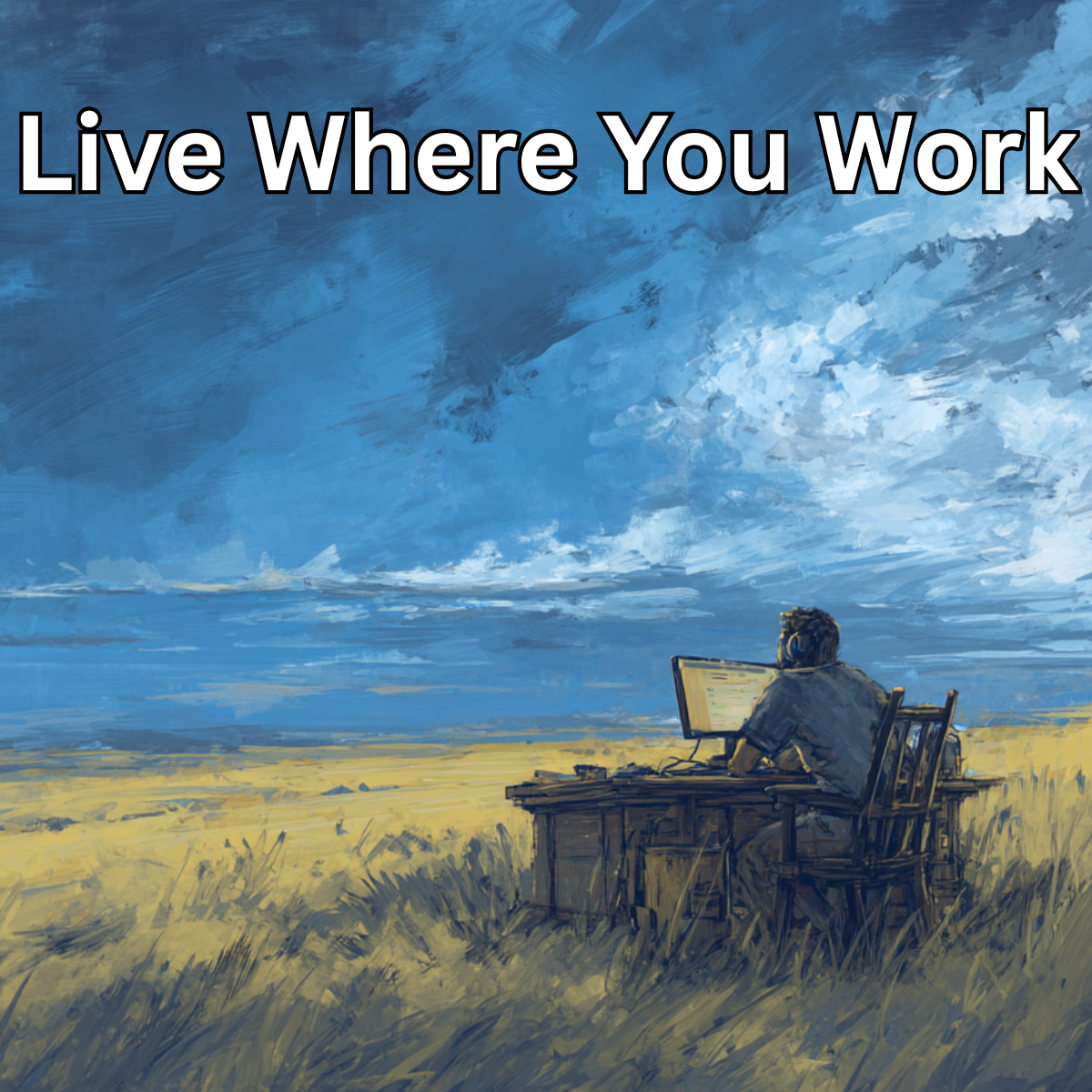
One of the most influential writers I have come across in my lifetime is Wendell Berry. One of the principles he spoke about was how moving people away from their homes was one of the most destructive consequences of modern industrialization.
“When we no longer live where we work, and when we do not work where we live, we have abandoned the place to others.”
I have always “worked from home,” meaning that I have never really had an office. There were times when an office was set aside for me, but I rarely used it. So when COVID emerged, and the sudden realization struck the world that you could telecommute, it was no shock to me. In looking this up, it turns out that nearly 40% of people with advanced degrees work from home. Since 2020, the number of people across all education levels working remotely has continued to grow. This past year, data shows that almost 40 million people have an exclusively work-from-home occupation.
Before industrialization took root in the United States, most people not only worked from home — their work was their home. Over 95% of the population was considered agrarian: they lived on their own farms, grew their own crops, and raised their own livestock. Today, it is the exact opposite. Very few people “live off the land,” and those who do are often viewed as eccentric or even suspect — the fringes of society.
Last spring, I was comically trying to grow a tomato in my backyard when I realized how embarrassed my great-grandparents would have been to see my efforts. These were people who grew everything they ate. And here I was, dancing around the yard, holding a single tomato in my hand as if I had just vanquished the Vikings from my homeland. Sadly, it seems I am not alone. Most people today are completely unaware of what it takes to grow fruit, vegetables, or raise livestock.
Being around my home more often, and spending more time in my community, I started to notice things — things that I had missed when my head was buried in work. Some of these things are not necessarily good. Is this what Berry was warning us about? Good work connects us to the places and people around us. Bad work detaches us. To rephrase: good work is local, communal, and sustaining, while bad work is extractive, anonymous, and destructive.
I am not sure that working from home, on a computer, wearing a headset on Zoom calls is exactly what Wendell Berry had in mind. I suspect he would argue that when we live in one place, work elsewhere, and have no lasting responsibility for either, it weakens every part of society: the land, the community, the family, and personal integrity. Telecommuting might seem better than commuting to a far-off office, but it might not truly address the deeper issues Berry identified.
When I first read Berry’s most famous book, The Unsettling of America, I was enthralled by the vision he laid out. Living where you work fosters a deep sense of responsibility, care, and stewardship. You are more likely to take care of the land, community, and resources because your own life is bound up with their health and prosperity.
However, as I got older, I began to see that this might only be a dream for the wealthy few. The rest of us seem condemned to roles that alienate us from our work. Alienation happens when people are separated from the consequences of their labor — when someone works in a city office planning projects that destroy rural land, or when workers manage processes whose impacts they never see. Berry believed this disconnection leads to environmental degradation, social decay, and personal dissatisfaction.
Does it really have to be so extreme? Must we either live isolated on a self-sufficient farm or sit in a tract home, tethered to a headset and a conference call?
I don’t think so. I believe there is a middle way.
We can find ways to reconnect with the places where we live. We can grow a garden, however small. We can learn our neighbors’ names. We can volunteer locally. We can pay attention to the land, the seasons, the needs of our communities. Even within a modern, digital economy, we can choose to participate in life around us rather than retreat into virtual spaces.
Berry’s vision is not about nostalgia for a vanished world. It is about recovering something timeless — the simple truth that our lives are bound to the places we inhabit. To neglect this bond is to lose something essential; to nurture it is to find ourselves again.
We may not all be able to live off the land, but we can live with the land. We can choose, each day, to be present where we are — and in doing so, we might slowly heal not just our communities, but ourselves.