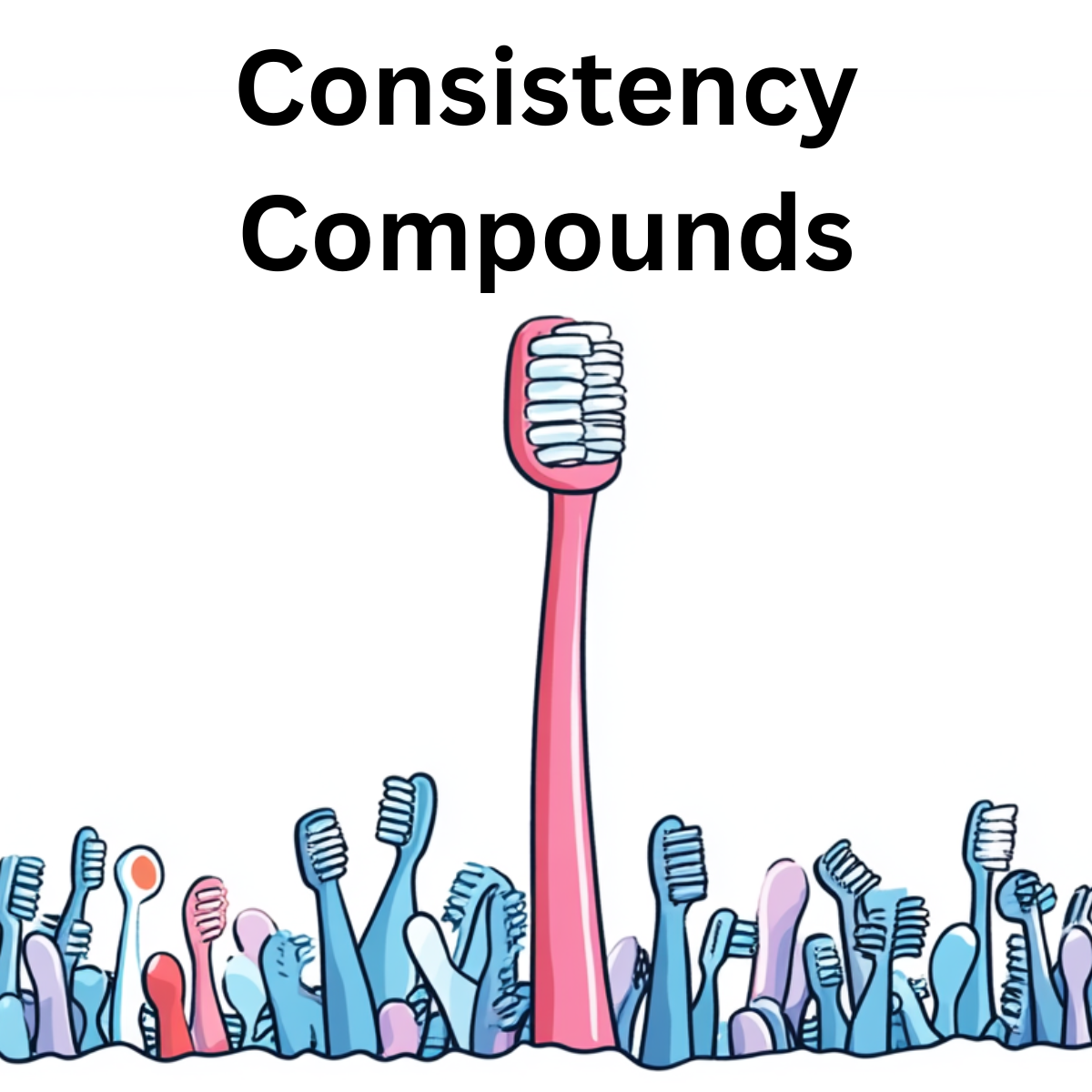
A mediocre idea repeated consistently is usually more powerful and transformative than a brilliant idea performed sporadically—because consistency compounds, while brilliance fades without action.
This is a tough lesson that every aspiring professional or entrepreneur must learn.
When I was younger, I always felt that my success was just one idea away—meaning that if I could just come up with a great idea, then all my business problems would be solved. What I learned much later in life was that it wasn’t the great idea that propelled me. It was the consistency behind an average idea that brought real success.
The questions you should be asking aren’t, “What should we…” or “What if we did…” but rather, “How often should we…” and “When are we…”
Earlier today, I was at my local pharmacy. While standing in the aisle waiting for my turn at the counter, I noticed a flashy advertisement for a new ultra-sonic toothbrush. It got me thinking: What would be better—brushing once a month with this expensive toothbrush, or brushing twice a day with the cheap ones next to it?
That’s an easy answer. Consistently brushing your teeth daily will produce much better results than sporadic brushing, no matter how fancy the technology.
Small, repeated efforts have a way of stacking up into something huge. The mediocre idea, done over and over again, builds momentum, creates systems, and forms habits. That consistency, over time, beats occasional brilliance—because real success is less about genius and more about showing up.
We spend so much time and money trying to concoct the perfect method or way. You can waste far too many cycles evaluating new strategies, ideas, and advice. Alternatively, you can just get started—following something consistently over an extended period of time, making small adjustments along the way.
Repeated efforts, even if imperfect, create a feedback loop. You learn. You improve. You adjust. Over time, what started as mediocre often evolves into something excellent simply through iteration and commitment. This is the big secret of the successful: momentum favors the persistent.
I was sitting in someone’s backyard recently, admiring the spa they had just installed. They had planted bamboo along the fence line in hopes it would soon grow tall and provide privacy. The planting had been done the previous summer, and while there were a few green shoots, it was nowhere near the lush wall of bamboo they were hoping for.
They were following all the instructions with precision, but the yield wasn’t meeting expectations. They were considering planting more—or ripping it out and trying something else. What they didn’t realize is that the bamboo was growing—just not in the way they could see.
Beneath the surface, the root system was rapidly spreading, likely over 40 feet in every direction. All that unseen effort was preparing for an explosion of growth. If they simply wait one more season, they’ll go from “not enough” to “too much.”
Was it growing all along? Yes—underground. The daily watering was building the foundation for what would become a stunning, rapid transformation.
Quitting too early is one of the most common and unfortunate mistakes of the unwise.
A great idea with no consistent execution is like lightning with no bottle. It might strike, it might dazzle—but it won’t light the path forward.
The world is full of “almosts”—people with genius-level insight who lacked the discipline to build something from it. You don’t have to look far to realize this. As I’m writing this, a package from Amazon was just delivered to my doorstep.
Amazon started as just an online bookstore—a mediocre idea by today’s standards. But Bezos was ruthlessly consistent in execution, iteration, and customer focus.
Compare that to countless startups with objectively brilliant ideas that died from inconsistent execution and lack of follow-through.
So remember these four concepts:
- Consistency beats intensity.
- Persistence beats brilliance.
- A repeated, average action builds a wall. A single great idea builds a brick.
- The magic isn’t in how good your idea is today—it’s in how often you’re willing to show up for it.