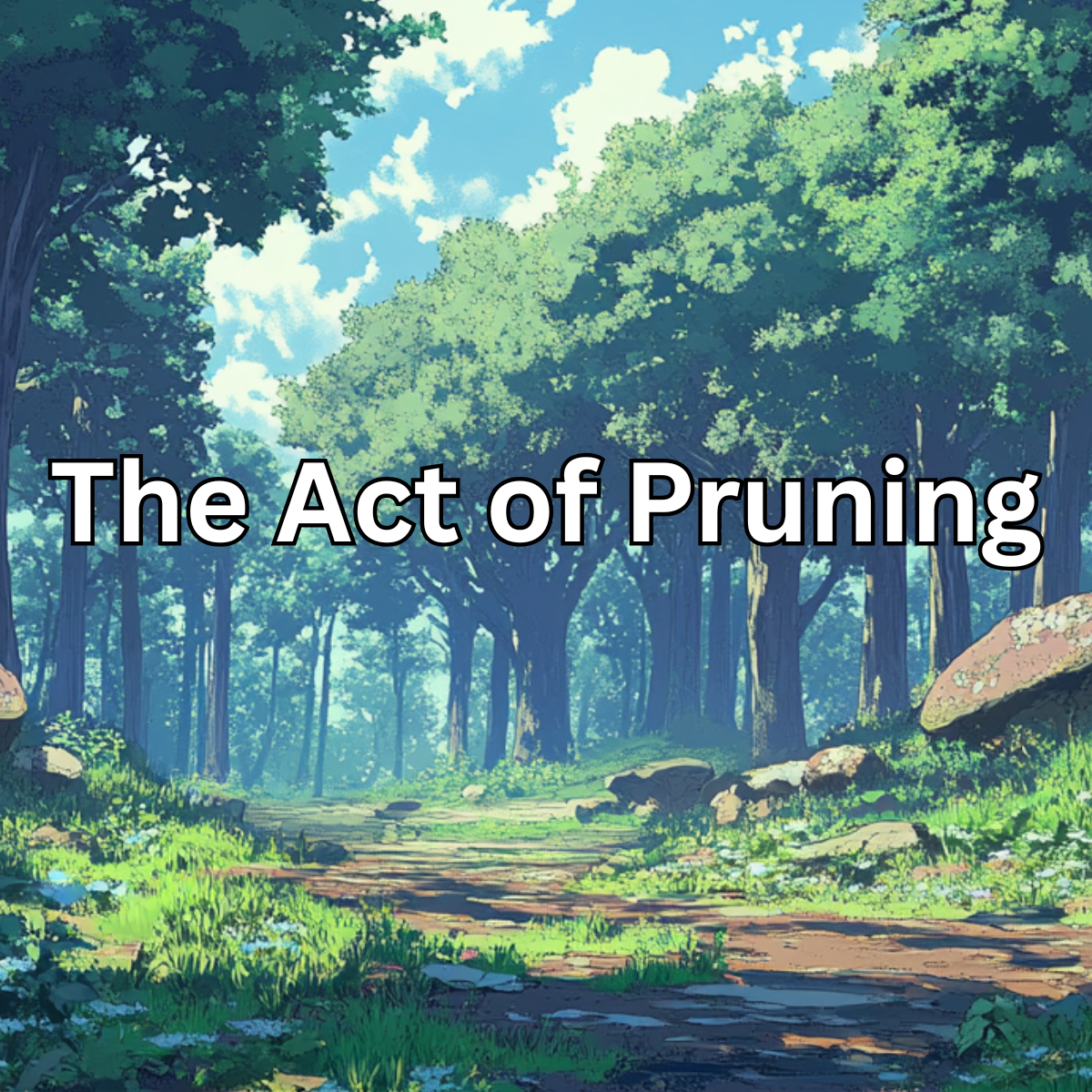
For some reason, I’m fascinated by pruning. I think it started with my rose bushes. When I first moved into my house, we had several rose plants put in the yard. One day, I came home to find my gardener cutting them all down—almost to the roots. I was perplexed.
“What are you doing!?” I called out, running over to him.
“Pruning,” he said calmly. “You need to cut the rose down for healthy growth in the spring.”
Sure enough, he was right. The next year, my little rose bushes came thriving back to life. That experience planted a thought in my mind that stuck with me: Without humans around to prune these vines, what would the plant do instead?
The answer to that question is complex. First, it’s important to realize that a wild rose bush is selected for its ability to survive, not for its beauty. Its goal is simple: survive and propagate the next generation.
Interestingly, nature does prune itself. Time, stress, and randomness cause damage, and the rose bush is uniquely designed to respond. We’ve just learned to take advantage of those traits to create beautifully shaped gardens full of flowers. In that sense, the relationship between humans and roses is symbiotic. By pruning the rose, we help it channel its natural strengths—to grow stronger, stay healthier, improve airflow, reduce disease, and produce vibrant blooms that attract pollinators. It’s a partnership that has worked remarkably well for over 5,000 years.
But pruning isn’t always a good thing.
Take, for example, the Japanese Daisugi method—a fascinating practice of pruning a specific breed of cypress tree. On an island where lumber is scarce, innovation that produces a renewable source of straight, consistent wood is incredibly valuable. With Daisugi, the base of the cypress tree is pruned to form a strong trunk, while its offshoots are cultivated into tall, straight vertical branches—creating surreal-looking trees and renewable timber.
While this technique produced elegant trees and useful lumber, it came at a cost. Because only certain breeds of trees produced the desired result, genetic diversity in Daisugi forests was severely limited. This made the trees highly vulnerable. Entire groves could be wiped out in a single season by beetles or disease. In this case, the relationship was not symbiotic at all—it was manipulation. The pruning met human needs, but it didn’t produce a stronger tree.
This contrast led me to a conclusion today.
When teaching, training, or mentoring others, there are times when you need to be an agent of change—when some pruning is necessary. This can be a good thing. People often do grow back stronger after being challenged or humbled. But this process should be thoughtful and deliberate, especially when it involves your children, loved ones, or people who trust you.
Is it manipulative? Not if your intent is right and it’s truly your role to do so. If you’re the gardener, it’s your job to prune. If you’re the parent, the coach, the boss—then yes, it’s part of your responsibility. But never take the shears to someone else’s garden. If it’s not your role, it’s not your place.
That’s one example of when not to prune—when it’s someone else’s responsibility. Another is when the timing is off—too soon, or too late. Timing is everything. I would never prune my rose bushes in the middle of summer or during a vulnerable time.
And one more thing: never top a tree. Topping—cutting off the upper branches to control height—almost always weakens the tree, making it more susceptible to disease and stress. It damages its natural shape and strength.
So here’s the lesson: Don’t prune when it’s unnecessary. Don’t prune if your intent is selfish. And don’t prune what you haven’t been entrusted with.
Intent matters—a lot.