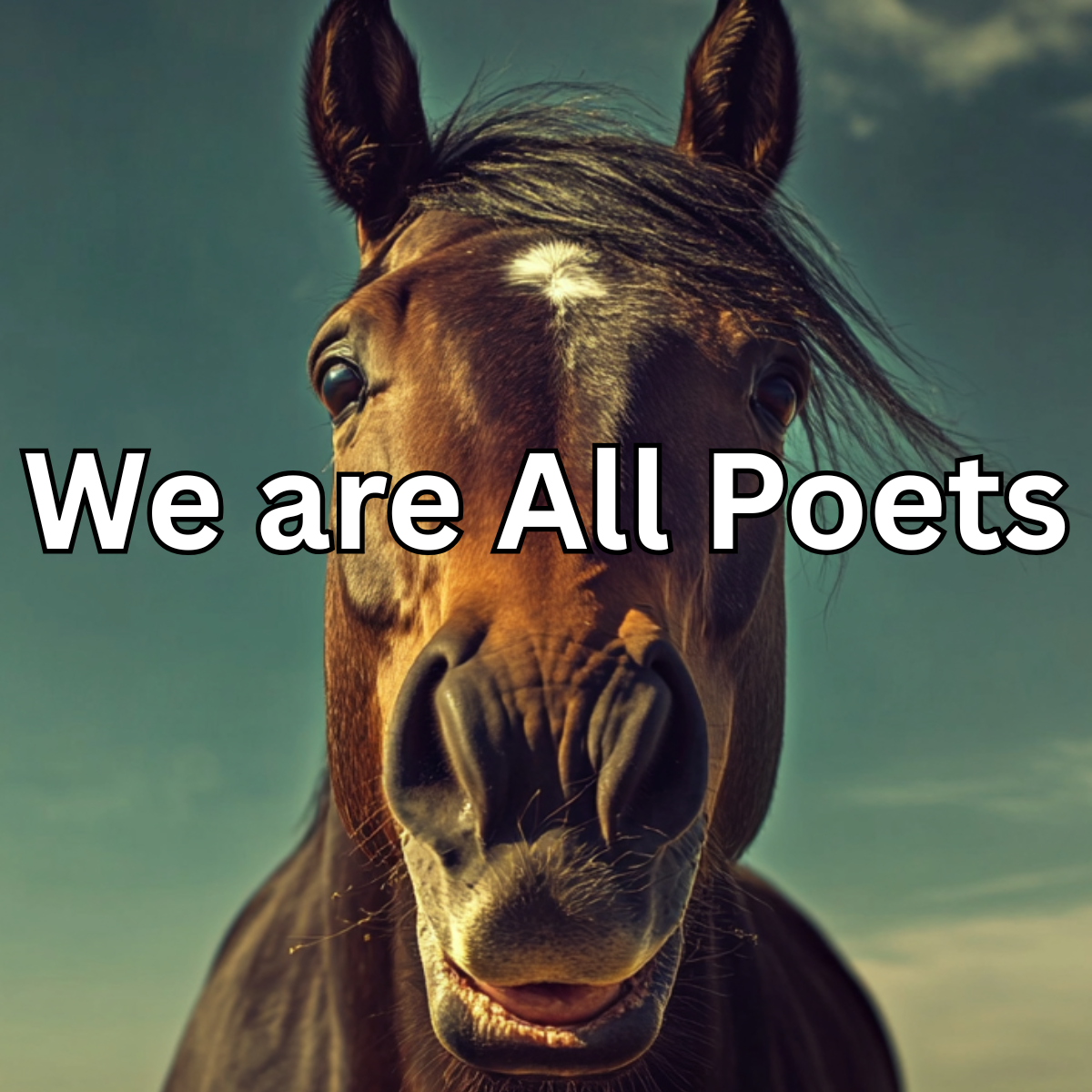
We are all poets — just not very good ones. We love to paint pictures with our words rather than stick to plain facts. If an alien species came to our planet, read the rule book for our language, and then listened to our conversations, they would be utterly confused. They would likely conclude that we are constantly lying to each other, even when we are not.
Have you ever heard someone preface what they are saying with “speaking figuratively…” and then not use any comparison, exaggeration, metaphor, or symbol at all? Or consider when people say “literally” — “I am literally dying over here.” Of course, they are not actually dying. They are using literally to intensify their figurative exaggeration. You see, we humans are all poets — the stark, raving lunatic kind.
Try this one day: wake up determined to listen carefully for whenever someone uses a figurative statement as opposed to a literal one. As you sit down to breakfast, instead of hearing “I am hungry,” which is literal, you’ll hear something like “I am so hungry I could literally eat a horse.” That’s an exaggeration meant to express how hungry they feel. You might see someone running and say “Wow, she is very fast,” but more likely you’ll hear “She runs like the wind.” By comparing someone to the wind, we add emotion and emphasis.
Humans do this so often that we have hundreds of words to describe the behavior. We have metaphors, similes, personifications, hyperbole, and expressions. A particularly good one will often catch on and spread until it becomes a common phrase. Some are more powerful than others. One metaphor I remember from childhood is “Hope is the thing with feathers.” This is the title of a poem by Emily Dickinson, if you don’t recognize it. It’s a beautiful metaphor comparing hope to a strong-willed bird. We all carry hope within us, always present, always offering a song, never asking for anything in return — much like that little bird that sings outside your window every morning. Well, your hope might ask for a crumb — if you’re willing to give it.
I bring this up because last night my wife reminded my daughter to do something for “the millionth time.” My daughter objected — quite factually — that it had not been a million times. My wife quickly responded that my daughter was “dancing on thin ice” and “playing with fire” — both at the same time! I chuckled, listening to figurative statements being tossed back and forth like daggers. It reminded me of my own childhood, where I often found myself “rattling the cage of the one who holds the key” and “waking the dragon before breakfast.”
Yesterday, I tuned my ear for these expressions. Some are so common that they slip by unnoticed. I can almost guarantee you’ll hear someone say “throwing someone under the bus,” “opening a can of worms,” or “finding the tip of the iceberg.” People wax poetic all the time without realizing it. That led me to this thought: what if we consciously trained ourselves to use new and more inspiring figurative statements in our daily speech?
It’s fun to watch new ones catch fire on the internet in the form of memes and repeated phrases. Recently, I heard “living rent-free in your head” used to describe obsession. How many times have you heard someone accused of “gaslighting” or giving off “main character energy”?
So why not create our own? I thought it would be hard at first, but it’s not. Simply take a common feeling, frustration, or predicament and come up with an analogy or expression that exaggerates it. I chose the feeling of being overwhelmed — something very familiar to me.
Sure, I could use fallback phrases like “drinking from a firehose” or “buried” today. But I wondered — how could I better express the emotion behind it? How could I make someone feel what I’m experiencing?
I could go poetic: “Caught in an avalanche of demands.” Or “Sinking in quicksand made of appointments and tasks.” These are good, but perhaps not catchy enough. Maybe something more humorous?
“Herding a bunch of caffeinated cats.”
“Juggling ten flaming swords while blindfolded.”
Now we’re talking! If you used one of these in conversation, I bet people would pause, laugh, and actually listen to what you were saying. We’ve become so desensitized to old expressions that we rarely consider how stale they’ve become.
I realize that changing the way a culture fancies figurative expressions is like “trying to lasso the wind.” But we could certainly enrich our own language by being more mindful and creative with the expressions we use.
So today, I’d love to be “floating through a cloud of quiet moments” or “drifting on a lazy river of time.” But most likely, my day will be spent serving my youngest daughter. I will be the “CEO of Chaos, Inc., working a weekend of unpaid overtime.” More specifically, I’ll be a “circus juggler in a three-ring show of snacks, water bottles, and basketballs.”
We are all poets — whether we know it or not. Our speech is a living canvas, painted daily with metaphors, exaggerations, and symbols. So why not make it artful? The next time you speak, try reaching for a new, colorful way to express yourself. You might just catch someone’s ear — and spark their imagination.