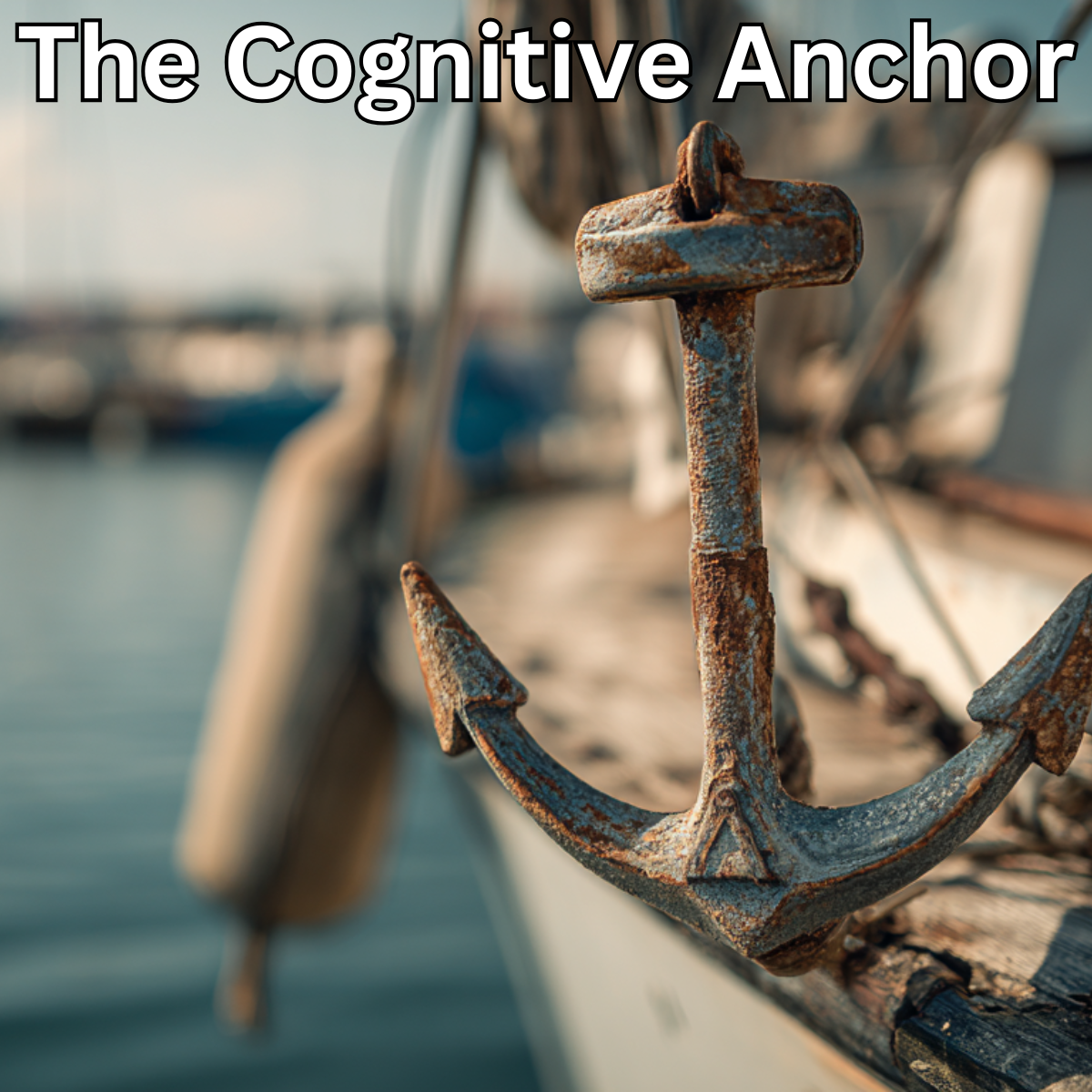
Today, I had to take off for lunch and visit my boat. A potential sucker, ah… I mean buyer, was looking to make a boat purchase. While I was there, I noticed that my anchor had come loose and was dangling by the chain from the bow. This was concerning because I do not want it to cause any hull damage during high winds. As I was re-securing the anchor, my mind drifted to an earlier conversation I had with my team. We had a great conversation, but something was missing. After a few moments, aided by my current boat issue, it came to me, we need a cognitive anchor.
Everyone enters into a situation with a frame of reference. If you do not understand someone’s frame of reference, you might talk past each other, misinterpret intent, or overlook valuable insights. Clearly, it is important to understand a person’s frame of reference to improve communication and build trust with someone. However, with a team that is working on a project together, just understanding their frame of reference is not enough. You need something to ground everyone. This mechanism, or cognitive anchor, is usually a common mental model or problem frame that gives everyone a reason to work together and a direction to move in.
Although I understood this, I did not go about it the right way. I tried to challenge everyone’s thinking, to be more controversial, but midway through the meeting, I realized that I needed something stronger. What I needed to come up with was a guiding question, a central inquiry that sparks exploration and collaboration. Call this a hypothesis, or a key question that frames the problem. When a problem can be brought forward as a key question to ask, then it is a method of unifying a fragmented team around this particular question. You now have a cognitive anchor.
Creating a cognitive anchor in the form of a guiding question or hypothesis is such a powerful unifying force for a team because it provides clarity, focus, and shared purpose, all of which are essential for meaningful collaboration. In the absence of a clear focal point, teams scatter and people default to their own priorities, interpretations, and assumptions. A guiding question acts as a mental magnet, pulling everyone’s attention to the same challenge.
When you pose a well-formed question or hypothesis, you define what matters now. You invite the team to assign meaning to their work through that lens. Suddenly, diverse roles and perspectives have a common context. A question also invites thinking, exploring, and testing. It opens the door to collective problem-solving, rather than top-down execution. People feel more engaged when they are asked to solve a mystery, not just follow orders.
I have always noticed that one difficulty is keeping a group of divergent people all on the same course. Ambiguity is one of the biggest killers of team momentum. A cognitive anchor simplifies complexity by defining the current challenge, helping the team filter out distractions and know what not to do. A well-framed guiding question creates a temporary shared lens that aligns diverse perspectives. It becomes a bridge between functions, experiences, or even egos.
More importantly, a question that we all have to solve together ignites movement. It creates a tension that demands resolution, showcasing a gap between what we know and what we need to know. This gap naturally generates action, dialogue, testing, and iteration.
A cognitive anchor, especially a guiding question that needs to be answered, clarifies what matters. This aligns diverse perspectives, reduces friction among teammates, sparks curiosity, and provides a shared purpose. In a simple statement, it provides something for the team to rally around.
As the man who wanted to buy my boat stood there pondering his decision, I decided to test out my theory. I looked at him and said, “I know what you’re thinking. You’re wondering how to convince your wife to A, let you buy a boat, and B, actually spend some weekends on it with you.” I paused, resting my hand on the newly secured anchor. “Believe me, I know your dilemma. But maybe you’re asking the wrong question.” I told him he needed to frame the conversation with a different perspective. “Instead of asking, ‘Can I buy a boat?’ try this instead: ‘Where is a romantic place we can escape to every weekend to spend quality time together?’” I gave him a grin. “Try that cognitive anchor and get back to me. Just so you know, the price is going up.”