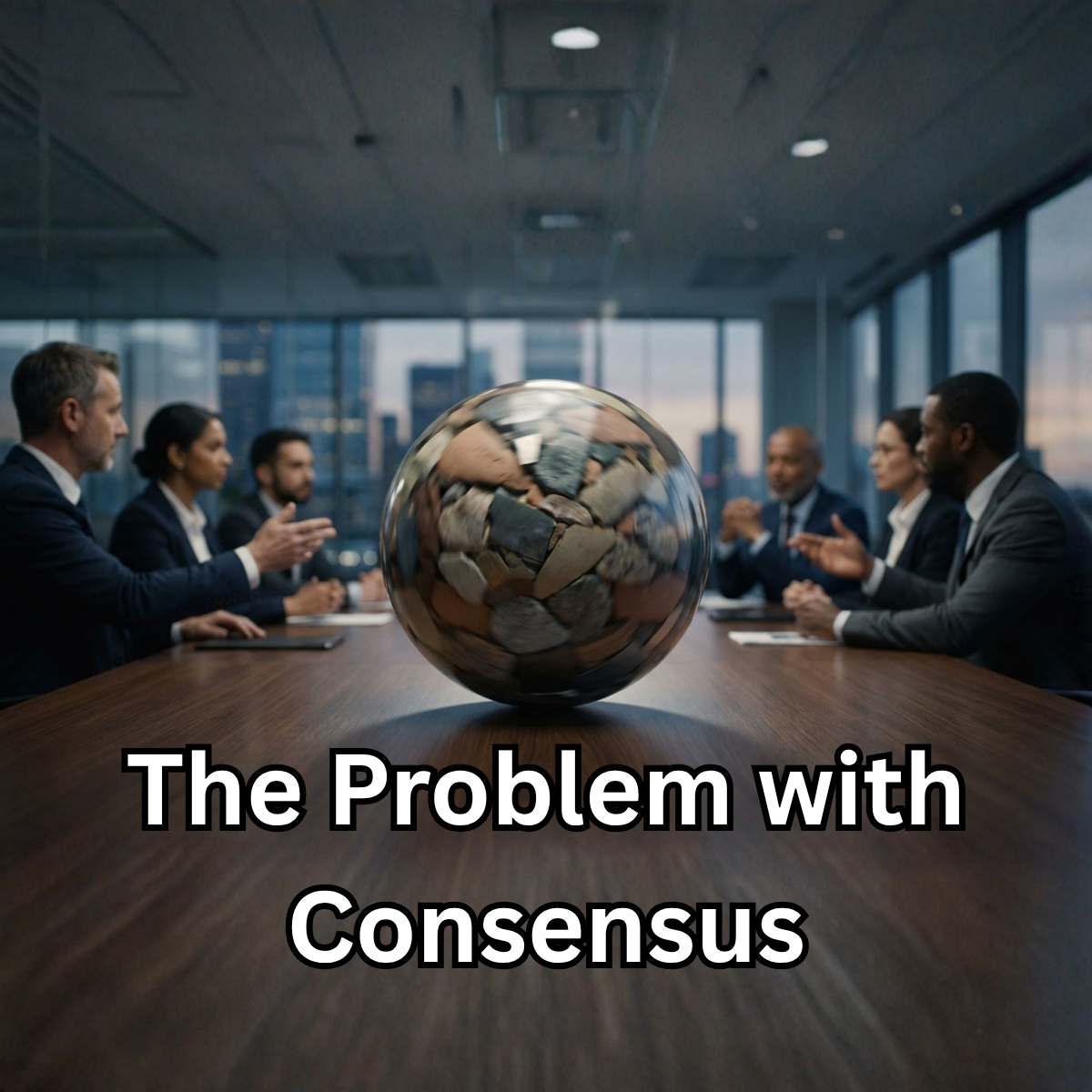
Consensus feels right because it signals fairness, inclusion, and alignment. But the mechanism of how consensus gets reached often systematically degrades the quality of the decision. When you aim for consensus, you are blending perspectives rather than choosing the best one. Bold ideas get watered down. Contradictions get smoothed over instead of resolved. You end up with the least objectionable option, not the most effective one.
You think you are lowering risk. You think you are shallowing up the areas where you could see large troughs, but at the same time you are filing down the peaks. In essence, this approach is flatlining the business. Think of the noise you hear in a hospital when the machine goes beep beep beep and then nothing.
Instead of seeking the best solution, you are coming up with what everyone can live with. Consensus optimizes for agreement, not truth or performance.
If you consistently do this, people in your organization will start to hold back dissent to avoid conflict. Pressure and groupthink will compromise your inputs. Consensus is almost never a true reflection of independent thinking. When everyone owns the decision, no one really owns it. This is a safe place for senior executives to hide. This leads to mediocrity by design.
Now, do not get me wrong. Consensus can be great, but that entirely depends on what you are working on. If you are coming up with a value statement, rules everyone must follow, and key principles of success, perhaps. However, for things like strategy, product decisions, high risk bets where you need judgment under uncertainty, uniform agreement will not get you there.
“Consensus is a coordination tool, not a decision-making tool.”
Consensus does not answer the key question: is this the right decision? It only tells you whether people can agree. Those are two different things entirely.
I have learned over time that to be successful you must separate input from decision. You encourage and embrace input, even when it is conflicting. You listen carefully. You consider the perspectives. Then you make the decision and you move fast. This preserves the value of diverse thinking without diluting the outcome. Someone must own the call. Someone must be willing to choose the path forward, knowing not everyone will agree, knowing the risk is real.
The next time you feel the pull toward consensus, pause. Ask yourself whether you are optimizing for comfort or for the right answer. Then gather the input you need, make the decision, and move.