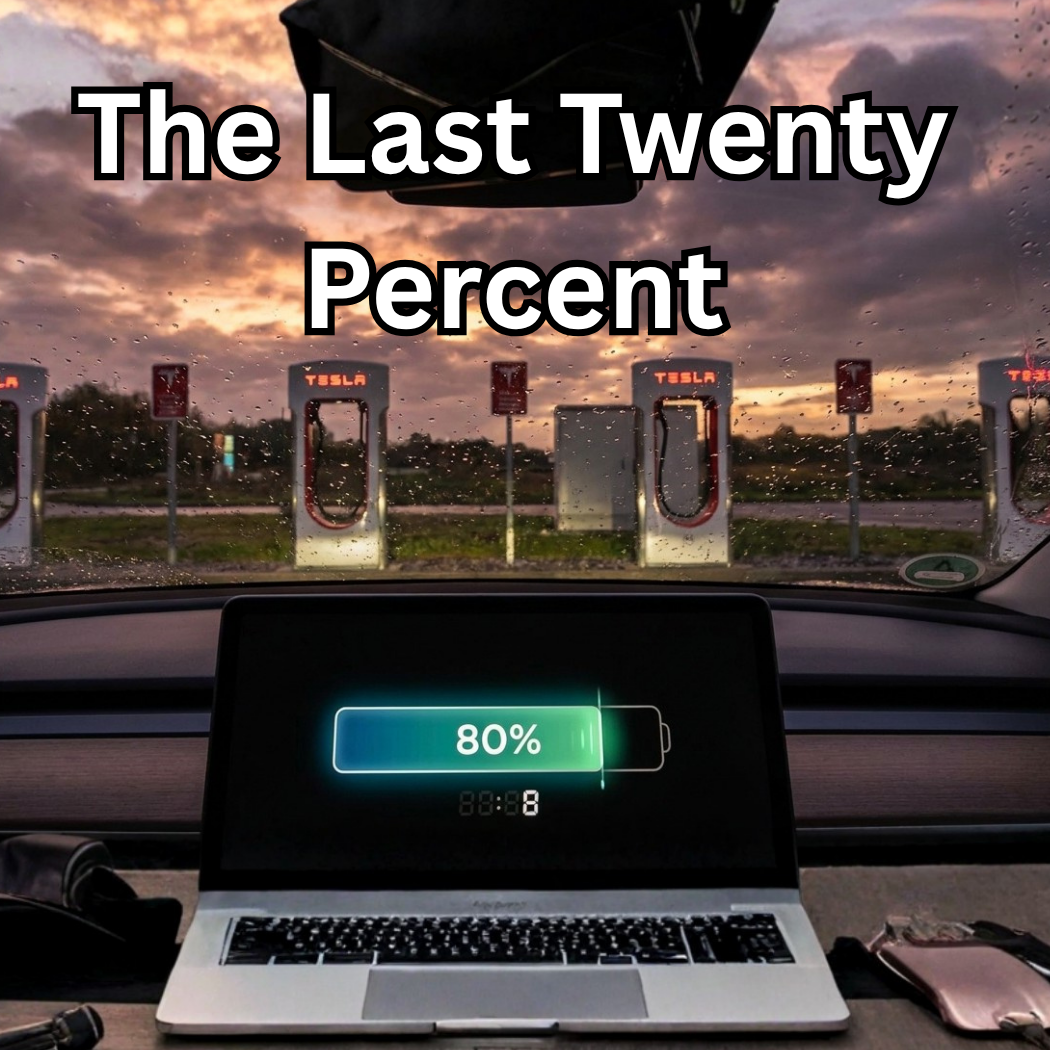
I was sitting in my car at a Tesla Supercharger, watching the numbers climb on the screen. At first, it was satisfying. The percentage jumped quickly. Twenty percent, thirty-five, fifty, seventy. It felt efficient. Like progress should feel. You plug in, and the system responds. Fast, predictable, rewarding. By the time it hit eighty percent, I had already mentally checked the box. Almost done.
And then it slowed. Not a little. A lot. What had been climbing steadily now crept forward. Eighty-one percent. Pause. Eighty-two percent. Longer pause. You could feel the difference, even if you did not understand the mechanics behind it. Something had changed.
I sat there thinking, this does not feel right. Same car. Same charger. Now I understand what is going on here. The charging system slows down on purpose as a safety precaution, the batteries start to warm up considerably at this stage.
However the last 20% has the same goal. Suddenly, it felt like I was working harder for less result, even though I was not doing anything at all. And then the thought hit me. This pattern is everywhere.
The Pattern We Miss
I started thinking about all the projects I have worked on over the years. Business ideas. Proposals. Marketing campaigns. Even things outside of work. Fitness goals. Writing. Personal commitments. So many of them follow the same pattern.
At the beginning, there is energy. Clarity. You can see the path. You make progress quickly, and that progress fuels you. It reinforces the belief that you are on the right track. You do not question much in that phase. You just go.
And then somewhere along the way, usually when you are pretty far in, it changes. You do not always notice the exact moment, but you feel it. The progress slows down. The work gets more detailed. The problems become less obvious and more frustrating. What used to feel like momentum starts to feel like resistance.
That is the part we do not talk about enough.
Sitting there, watching eighty-three percent take longer than the previous twenty percent combined, I started wondering how many things in my life had stopped right there. Not at the beginning. Not when things were clearly broken. But right at the edge of being finished.
Projects that were eighty percent complete. Maybe even more. Things that had real potential. That were close to being something usable, something valuable, something real. And yet, they never crossed that line. Not because they could not. But because the experience changed.
When Fast Becomes Slow
When you are at twenty percent, you expect it to be hard. When you are at eighty percent, you expect it to be almost done. So when it suddenly becomes harder again, it feels like something went wrong. Like maybe the idea was not as good as you thought. Like maybe you misjudged it. Like maybe it is time to move on to something else. Something new. Something that feels like the first eighty percent again.
But sitting there, I realized the charger was not struggling. It was not broken. It was doing exactly what it was designed to do. Slowing down on purpose. Because the last twenty percent requires more precision. More care. More control. You cannot just force it in at the same speed without consequences.
Fast gets you most of the way there. Slow gets you finished.
And that is when it really clicked. Maybe the problem is not that we abandon things too early. Maybe it is that we do not recognize the moment when the work changes. We treat the last twenty percent like it is supposed to feel the same as the first eighty percent. And when it does not, we interpret that difference as failure instead of progress.
“Fast gets you most of the way there. Slow gets you finished.”
I have started to notice it more now. That feeling when things slow down. When progress becomes less visible. When the work becomes less exciting and more exact. It does not feel like momentum anymore. It feels like effort. But instead of seeing that as a sign to step away, I am starting to see it differently. Like a marker. A quiet signal that says you are close. Closer than most people ever get.
The Real Question
I eventually unplugged and drove away before it hit one hundred percent. Not because I could not wait. But because I did not need to. Eighty percent was enough for the car. But that moment stuck with me. Because in most areas of life, eighty percent is not enough. It is just where things start to matter.
Maybe the real question is not how many things we start. But how many we are willing to stay with when it stops being fast. The next time you feel that shift, when the work slows and the progress becomes harder to see, do not mistake it for failure. Recognize it for what it is. The signal that you are entering the last twenty percent. The part that separates the people who finish from the people who almost did. Stay with it. The work changes because you are close.