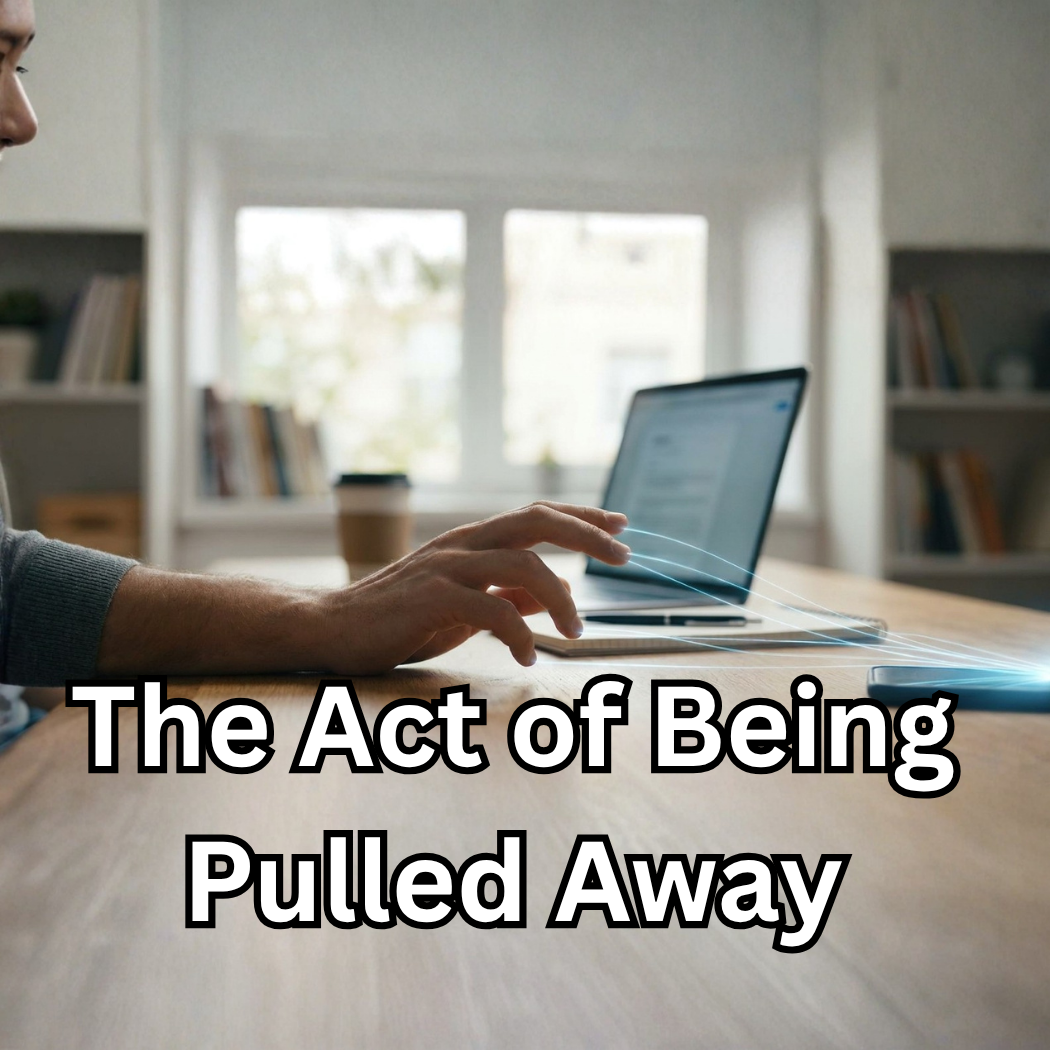
I was sitting at my desk this morning when I noticed my hand reaching for my phone. I had not decided to check it. I had not heard a notification. My hand just moved on its own, as if something invisible had tugged at it. That moment made me stop and think about what was actually happening. I was not losing focus. I was being pulled away from it.
The word distraction has been on my mind lately. Not because I am immune to it, but because I keep falling into it. So I decided to look at the word itself, to see what it could teach me.
The prefix dis means apart, away, or not. The root tract comes from the Latin trahere, which means to pull or draw. The suffix ion turns a verb into a noun, marking the act or process of something. Put them together and you get distraction, which literally means the act of being pulled away.
That definition landed differently than I expected. I had always thought of distraction as something I allowed to happen, a failure of discipline or focus. But the word itself suggests something else. It suggests a force acting on me. Something is pulling me away from where my attention should be. I am not just wandering off. I am being drawn off course.
That distinction matters because it changes how I think about the problem. If distraction is just a lack of focus, then the solution is to try harder, to will myself into staying on task. But if distraction is something pulling me away, then the solution is different. I need to understand what is doing the pulling and why I am letting it.
Humans are built to notice things. We are tuned to capture everything around us. That ability kept us alive for thousands of years. We could hear the rustle in the grass, see the movement at the edge of the clearing, sense the shift in the air before the storm. We have amazing filtering capabilities, but we are also highly aware of everything happening around us. That awareness is a strength, but it also makes us vulnerable. We are wired to respond to signals, and the world we live in now is full of them. Notifications, messages, updates, alerts. Every one of them is designed to pull us away from what we were doing.
The problem is not that we are weak. The problem is that we are exactly what we were designed to be. We notice. We respond. We get pulled.
So the question is not how to stop being distracted. The question is how to recognize when something is pulling me away and decide whether I am going to let it.
I have started paying attention to that moment when my hand reaches for the phone or my eyes drift to the screen. I do not judge it. I just notice it. I ask myself what is pulling me right now. Is it something that matters, or is it just noise? Most of the time, it is noise. And once I see it for what it is, the pull weakens. Not always. But often enough that it makes a difference.
“You are not just losing focus. You are being drawn off course.”
This is not about perfection. I still get pulled away. I still lose time to things that do not matter. But I am getting better at recognizing the pull before it takes me too far. I am learning to see distraction not as a failure, but as a force I can choose to resist.
The next time you feel your attention drifting, pause. Do not judge yourself. Just notice what is pulling you. Name it. Then decide whether you are going to let it draw you away or whether you are going to stay where you are. That small act of noticing is enough to change what happens next.