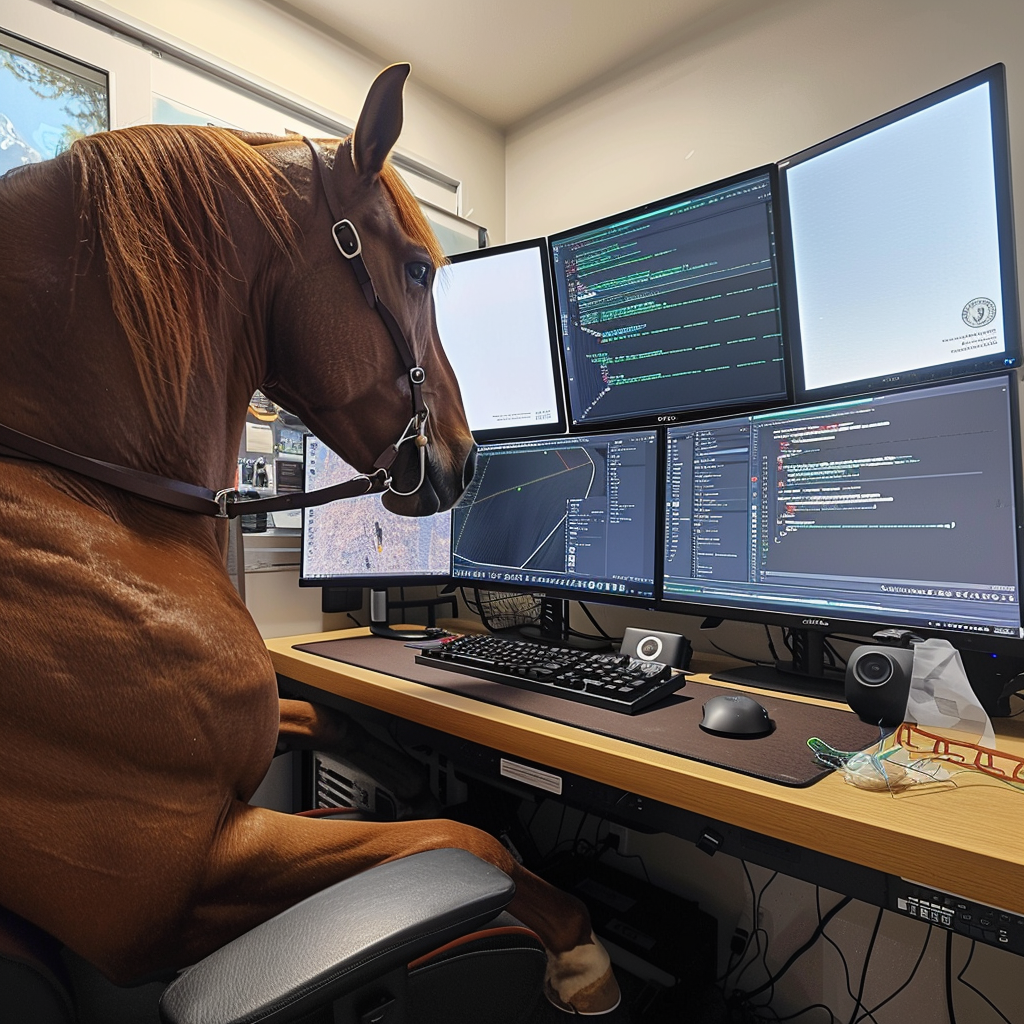
Humans have a vertical field of view of about 135 degrees vertically. This allows us to see above and below us. We have about 180 degrees horizontally, so we can see on each side of in a pretty wide field of view. A few interesting concepts about human vision. Our central and primary vision is approximately 5 degrees, and this is where we get really detailed. The rest of our vision is peripheral, in which we do not see detail but rather pick up mostly motion and spacing. As I type here, I can see these words clearly, but if I look into the periphery, I notice that the words on the monitor to the left and the right are not distinguishable. I can see some general colors and some shapes, but for the most part, I cannot see the detail. When I decided to shift focus, it took a few seconds to readjust focus. Our brain actually fills in a lot of the details automatically, making large guesses about what should be in the view.
Human Vision and Survival
Human vision has evolved over time to keep us alive. It is a marvel of organic engineering, really, if you consider all that is happening. The two eyes have an overlapping field of view so that we can perceive depth. This is all amazing, really, which will lead to my ultimate point here in a minute, but let’s consider horses next. Horses also have an incredible vision mechanism. Most people do not realize that horses can see 360 degrees. Seeing the world around them completely without moving their heads. So, as they run through a field, they see everything. They also see the two eyes completely separately, which is wild to think about. They also can see depth, but only right in front of them, so they can distinguish obstacles and danger. There are a few other nuances, different color receptors and night vision. However, the one I want to focus on is the fact that horses are highly sensitive to motion.
Using Blinkers for Focus
A common practice is to use blinkers or blinders on a horse to narrow its field of view. Due to their sensitivity to motion and incredible field of view, people will put these on them to reduce their vision to what is in front of them instead of the entire world around them. This way, they will not get distracted, spooked, or scared. This is important for horses that are pulling carts, passengers, and things like carriages. You cannot have a horse getting spooked while carrying passengers on their romantic carriage ride through the city.
The Evolutionary Purpose of Vision
This all leads to a point. Although horses have different visions than humans do, they both evolved for the same purpose: survival. We both have an incredible ability to capture the world around us, process it, and detect motion, threats, or interesting objects that can aid in keeping us alive. We are really good at it. A horse is probably better, but humans are quite capable as well. We may not be able to see as well at night, but we do see a wide spectrum of color and our focus capability is much more advanced.
Modern Distractions and Vision
The point is that you are no longer in a situation where you are roaming around the world in constant danger. Most of us are in safe, regulated environments where our relative safety is secured. However, we have the vision capability of any other mammal, and that is a highly tuned machine that is designed for us to get distracted so we can avoid harm. Suppose we waltz into our office and sit in front of our multi-monitor computer setups, and open up 200 Chrome tabs and various other applications. In that case, we are aligning this perfectly aligned vision machine to get distracted all day long. You will be constantly noticing things, and your mind will kick as you process these for harm or benefit. We must use blinders, or we are doomed to constant distraction.
Using Symbolic Blinders
I do not mean horse blinders in the physical sense. I mean, blinders in a symbolic sense. Removing all sources of distraction in our peripheral vision so that we can focus on the task at hand. Remove things that can get in the way and pull your mind away from your focus. Remember, you are designed for optimum distraction. You cannot fight hundreds of thousands of years of genetic engineering. If there is something on your screen or in your work environment that can distract you, you will be distracted. So my advice, put on your proverbial horse blinders and block everything else from grabbing your attention, and see how much more you can accomplish.
Hmm. Wait a minute. What is this in my feed? Another cool blog article about NVIDIA taking over the Universe? I must read it.