I met a young man in an interview today who suggested that because I was running an AI company, I should be using AI tools to automate more so I could employ fewer humans. This is true, but here is the problem. Using AI simply means the organic growth accelerates. So it is not fewer humans; it is actually more humans, because as AI helps you gain traction and get through the easy stuff faster, the need expands to have more people in the mix managing, orchestrating, planting, and solving the myriad problems that your tool sprawl has now created for you.
Here is the silver lining, however. People are the catalyst for growth. You will always hire people who cause problems. They will create culture clashes, stir up conflict, spark office politics, and make demands. Then you will hire people who find new ways to solve challenges, discover new patches of dirt to plant in, and help this organic thing thrive. Put a bunch of people in the garden together, and suddenly your little plot is bursting with bounty in the spring as new growth takes shape.
This is the marvel, and that is when you realize you are not really in control anymore. The thing you created is now a living creature all by itself, with its own pulse, its own personality, and its own soul. The people you bring in start to force change, and often that change is good, and hopefully you are not too stubborn to get in the way. You created this mess, and your weaknesses magnified the problems; now you get to watch as the organic creature you made starts to heal itself and grow in ways you never thought possible.
So never forget, when you bring that young bright eyed kid into the office for an interview, you may be looking at the next catalyst for positive change. The only way to fix an organic creation such as a startup environment is to introduce new people.
The name of our new company, askturing.ai is fitting because I find myself asking the same question that Alan Turing posed in 1950 when he wrote his famous paper on computing machinery and intelligence. We may hope that machines will eventually compete with humans in all purely intellectual fields. But which are the best ones to start with? Even this is a difficult decision. Many people think that a very abstract activity, like the playing of chess, would be best. It can also be maintained that it is best to provide the machine with the best sense organs that money can buy, and then teach it to understand and speak English.
The last sentence of this paper is what stuck with me. Even though we can only see a small distance in front of us, the amount of work that needs to be done remains significant. I think that was as true in 1950 as it is now in 2025.
As I have been building and taking this AI engine to market, I have been experimenting with what is possible. The adventure has been crazy, unpredictable, and filled with moments that no algorithm could have anticipated. Just like Turing asked almost a century ago, I am asking, what makes a human uniquely human? As AI advances continue, the open question stands out, what is the human value proposition?
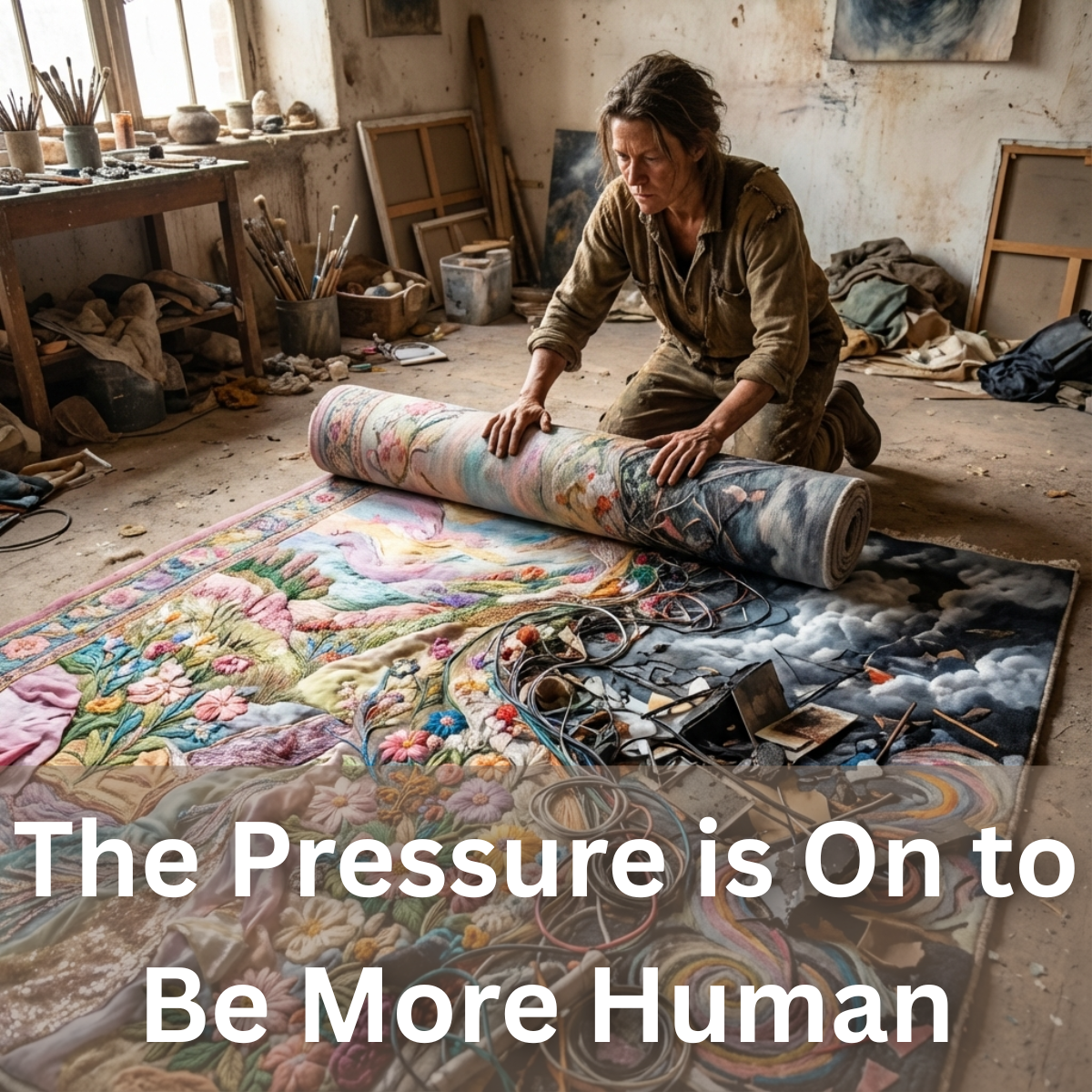
I came across this revelation this morning. Now that AI is taking care of simple, repetitive tasks, the pressure is on for us humans to be more human. Meaning to be more creative, to be more unpredictable, to come up with connections that no machine could ever do. Our role in the future seems to be precisely that, more human. Mistakes and beauty all rolled up in one.
There will be a time, in the not too distant future, when we just cannot afford to wait fifteen to twenty years for a young person to learn all the fundamentals before they can become productive. We are going to want them to start being productive at a much higher level when they leave the school system. Perhaps it is time to demand more of our young people. They have a human brain that is highly capable and incredibly efficient, especially when they are young. Maybe it is time to force them to actually use it.
The only way we are going to produce engineers, scientists, authors, and researchers who can break new boundaries is by getting them started younger and getting them comfortable with using tools that will rapidly extend and magnify their capabilities. The ship has sailed. We decided as a society that it was perfectly acceptable to hand our children small digital devices that allowed them to communicate with the entire world. So now we are stupefied that these young people are using modern AI tools to create memes, AI videos, and silly fakes of their friends in compromising situations.
We created this monster, so perhaps instead of trying to slow it down with tactics that are not going to work, we should just exponentially increase the sophistication and quantity of what is required. Of course, this will lead to an even wider gap between those who have access to this technology and those who do not, but that is a topic for another day.
Consider the fact that our imagination of our interactions with others is not only amplified by social media but also exponentially impacted by Artificial Intelligence. Understanding our drive to manage our perceived appearance to others seems more relevant than ever. Do we seek to amplify how we think others perceive us, or do we strive to amplify who we truly are?
This is where the human value proposition becomes clear. Machines can process, calculate, and optimize. They can handle the repetitive, the predictable, the algorithmic. But they cannot be messy. They cannot be beautifully flawed. They cannot make the kind of mistakes that lead to unexpected breakthroughs. They cannot feel the weight of a decision in their gut, or trust an intuition that defies logic, or create something that surprises even themselves.
The future belongs to those who can be more human, not less. Those who can embrace the chaos, the creativity, the unpredictability that makes us who we are. Those who can look at a problem and see not just the solution, but the poetry in the struggle. Those who can connect ideas that have no business being connected, and in doing so, create something entirely new.
This is what I have learned building an AI company. The more powerful the machines become, the more valuable the human becomes. Not in spite of our imperfections, but because of them. Our mistakes are not bugs; they are features. Our unpredictability is not a weakness; it is our greatest strength. Our ability to be beautifully, messily, gloriously human is the one thing no machine will ever replicate.
So when you bring that young bright eyed kid into the office for an interview, you may be looking at the next catalyst for positive change. Because in a world of perfect algorithms and flawless execution, what we need most are people who can be imperfectly, wonderfully, undeniably human.