I love going into the wilderness on backpacking expeditions. There is something about stepping away from the noise of normal life and walking into the mountains that clears the mind. The air is different. The rhythm is different. The concerns of everyday life seem to fade into the background, at least for a little while.
But before every trip, there is one part that is never as romantic as the pictures make it seem. Choosing the destination. That is always the hard part.
Everyone has an opinion. Someone wants alpine lakes. Someone wants solitude. Someone wants big views. Someone wants fewer miles. Someone wants a loop. Someone wants a peak. Someone wants a place they have already been because they know it is good. Someone else wants to try something completely new. The debate can go on forever.
But once the destination is chosen, something interesting happens. Most of the other decisions become practical. How many miles? How much food? What gear? What is the water situation? How much elevation? Where do we camp? What time do we start?
And then, once we actually begin, we usually find the trail.
Most of the backpacking I have done has been on established trails. They may be difficult. They may be steep. They may be rocky, exposed, wet, hot, cold, or exhausting. But they are still trails. Someone went before us. Someone cut the path. Someone maintained it. Someone put signs at the junctions. Someone mapped it. Someone uploaded the route. Someone wrote a trip report. Someone told us where the water would be and where the climb would hurt.
Every once in a while, we might lose the trail for a few moments. We step over a stream crossing and wonder where the path picks back up. We wander across a granite slab and have to look for cairns. We get distracted and drift onto a side trail. But for the most part, the path has been predetermined.
We are not really discovering the way.
We are following it.
I think that is how most of us go through life. We follow prescribed paths. We go to school. We get a job. We learn a trade. We climb a ladder. We follow a career track. We take the next logical step. We look at what others have done before us and try to do something similar, maybe a little better, maybe a little faster, maybe with our own personal variation.
There is nothing wrong with this. In fact, there is wisdom in it. A well-worn trail exists for a reason. It reduces risk. It gives confidence. It provides direction. It allows us to focus on endurance, discipline, and execution instead of constantly wondering whether we are even going the right way.
Following a path can still be hard. Anyone who has climbed a mountain on an established trail knows that a clear path does not make the climb easy. It just makes it knowable.
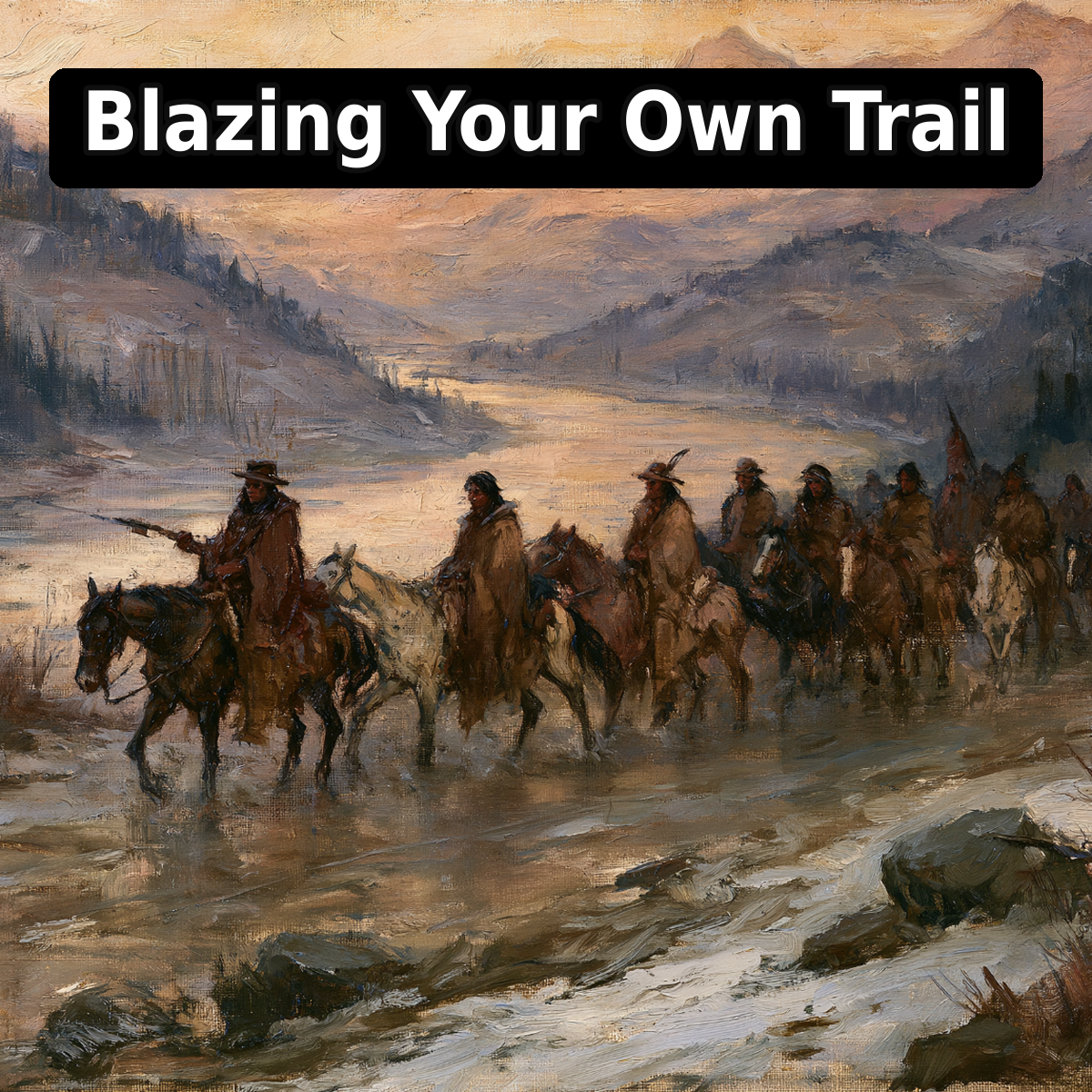
But I was thinking recently about Meriwether Lewis and William Clark.
President Thomas Jefferson sent them west after the Louisiana Purchase to help understand the land the United States had just acquired. They had some maps. They had some reports. They had instruments. They had a mission. Along the way, they relied heavily on Native American knowledge, guides, interpreters, and relationships. They were not traveling through empty land, and they were certainly not the first human beings to know those rivers, mountains, plains, and passes.
But from their perspective, and from the perspective of the young United States, they were moving into a world without the kind of certainty we now take for granted.
There was no GPS. No satellite imagery. No downloadable GAIA route. No print-on-demand topographic maps. No trail reviews. No weather app giving hourly updates. No lightweight gear list refined by thousands of hikers before them.
They had to go out into the world and find a way.
That thought stayed with me.
Because I realized that a good part of my own career and life has felt less like following a trail and more like trying to find one.
There have been seasons where I did not have a clear path in front of me. I was not simply executing a known route. I was trying to figure out where to go, how to move, what to carry, who to trust, what signs mattered, and what obstacles were temporary versus permanent.
And when you are making your own way, you make mistakes.
Sometimes silly ones.
Sometimes stupid ones.
Sometimes painful ones.
You go too far in the wrong direction. You misread the terrain. You carry things you do not need and leave behind things that would have helped. You underestimate how hard the next section will be. You move too quickly when you should have slowed down. You hesitate when you should have committed. You confuse motion with progress. You mistake a stream for the main river. You follow something that looks like a path until it disappears into the brush. That kind of life has its own stress.
And I am not sure I understood that for a long time.
I think I spent much of my life assuming that everyone was carrying the same kind of burden. I thought the stress I felt was simply the normal cost of effort, ambition, responsibility, and growth. But I am beginning to understand that there is a difference between the stress of walking a difficult trail and the stress of wondering whether there is a trail at all.
Those are not the same thing.
When a path already exists, the challenge is endurance.
When no path exists, the challenge is judgment.
You have to decide where to step. You have to decide when to keep going and when to turn around. You have to learn from incomplete information. You have to make peace with uncertainty. You have to carry the consequences of decisions that nobody else could really make for you.
That can be exhausting in a way that is hard to explain.
It also creates a temptation toward self-criticism. When you are forging your own path, every mistake feels personal. Every wrong turn feels like evidence that you should have known better. Every delay feels like failure. Every difficult season feels like proof that maybe you were never qualified to be out there in the first place.
But that is not always true.
Sometimes the mistake is not proof of incompetence.
Sometimes it is simply the cost of exploration.
This is where I think we need more forgiveness for ourselves and for others.
Forging a new path is different from following one that already exists. It requires a different kind of courage. It exposes us to a different kind of failure. It asks us to live with ambiguity for long stretches of time. It forces us to become both traveler and mapmaker.
That does not excuse carelessness. It does not mean every mistake is noble. It does not mean wisdom, preparation, counsel, and humility are optional. Lewis and Clark did not succeed because they wandered blindly. They observed. They documented. They listened. They adjusted. They relied on others. They learned from the people who knew the land better than they did.
That may be the real lesson.
When there is no prescribed path, we still need guidance. We still need companions. We still need humility. We still need to pay attention. We still need to learn from those who have knowledge we do not possess.
But we also need to recognize the weight of the work.
Some people are walking established trails. Their path is hard, but visible.
Others are trying to find a route through country that has not yet been mapped for them.
Both require strength.
But they are not the same journey.
And for those of us who have spent a good part of life trying to pick our own way, maybe we should offer ourselves a little more grace. Maybe we should stop measuring every wrong turn as failure. Maybe we should recognize that the stress we have carried was real, even if we did not have language for it at the time.
There is a certain comfort in a well-worn trail.
There is also a certain calling in making your own.
And maybe, if we keep going with humility, courage, and a willingness to learn, the path we are struggling to find today may someday become a trail that helps someone else find their way tomorrow.