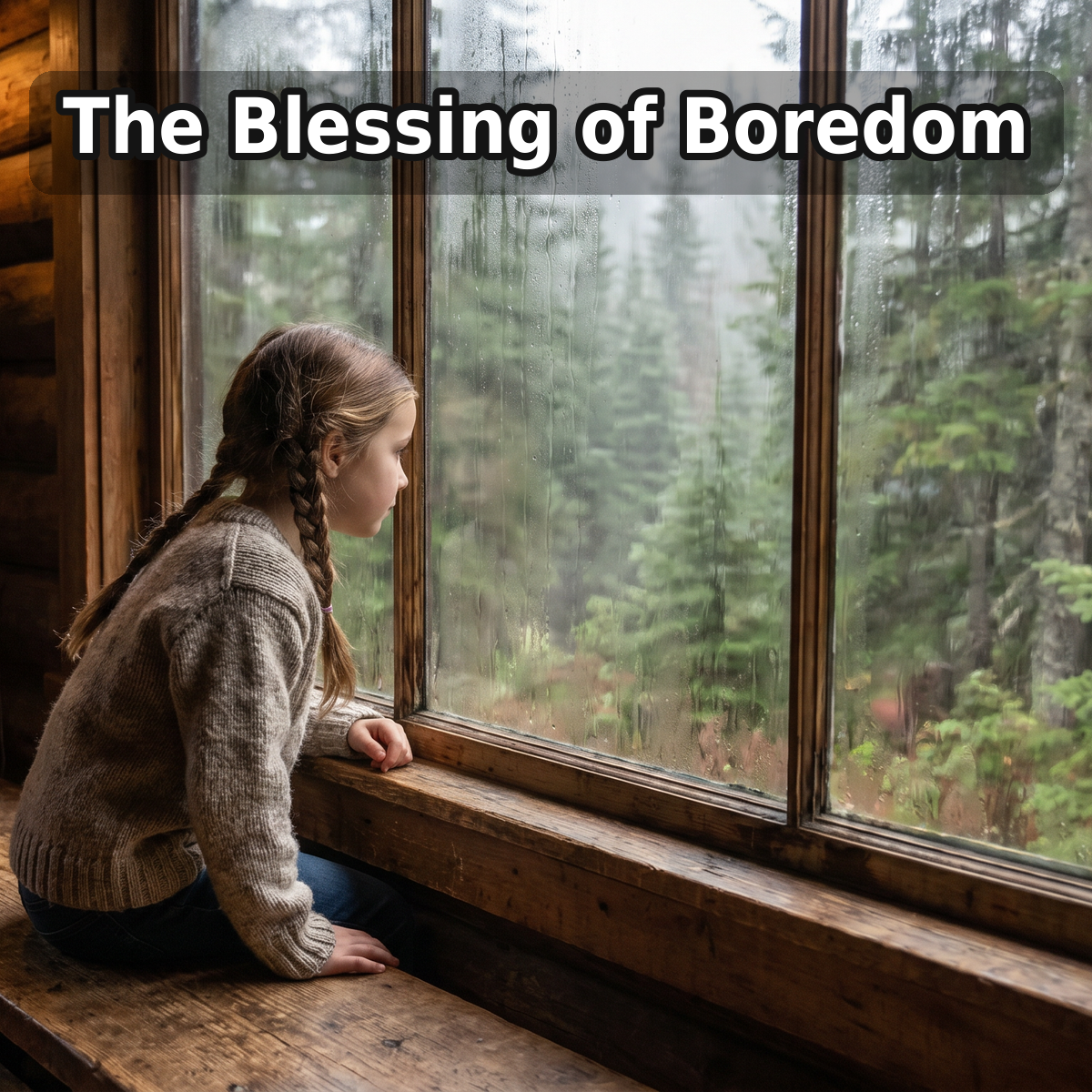
One of my children came to me recently and said she was bored. My first thought was not that I needed to fix it. My first thought was that boredom is a blessed feeling, and one I would love to have more often in my own life.
That response surprised me a little, so I stayed with it.
The more I thought about it, the more it seemed to say something about the moment we live in. We are in a rare time when a young person can actually be bored. For most of history, young people were not bored in this way. They were busy with work, duty, survival, or whatever their family needed from them. Boredom, at least as a regular complaint, feels like a luxury of comfort and abundance.
I do not say that to shame my child, and I do not say it to romanticize hardship. I say it because the complaint itself reveals something. If boredom shows up so quickly, maybe it is not always a sign that something is wrong. Maybe it is a sign that there is finally enough space for a person to notice their own inner life.
The urge to fill every empty space
My next thought was that maybe young people need less entertainment and more reflection.
That is easy to say about children. It is harder to admit about myself.
I live with a low hum of stress often enough that an empty moment can feel unfamiliar, almost suspicious. If there is a gap in the day, my instinct is to fill it, to reach for something, to keep moving, to stay occupied. I tell myself I am being productive, and sometimes I am. But sometimes I am just avoiding stillness.
That is the part that caught me.
“Maybe the overstressed person that I am needs to be bored more often in life.”
There is a difference between meaningful engagement and constant stimulation. One gives shape to a life. The other just keeps noise in the room. When every quiet moment gets covered over, there is very little chance to reflect on what I actually think, what I actually feel, or what might need to change.
Boredom may not be the enemy I often assume it is. It may be the awkward doorway into attention.
What boredom might be trying to give us
When a child says, “I’m bored,” the normal adult response is to solve the problem. Offer an activity. Turn on a screen. Suggest a game. Move things along.
Sometimes that makes sense. But I wonder if we are too quick to rescue people from that feeling.
If boredom is immediately removed, then reflection never has a chance to begin. Imagination never has to wake up. A person never has to sit long enough to ask, What do I want to do? What matters to me right now? What is this discomfort showing me?
I am not trying to turn boredom into a grand spiritual practice. Sometimes boredom is just boredom. But even then, it may have something to teach. It may expose how dependent we have become on being entertained. It may show us how little practice we have with silence, patience, or thought.
And maybe that is not only a problem for the young.
Maybe adults need this even more. Maybe those of us who are overstressed, overbooked, and overfilled need a few more unclaimed minutes in our lives. Not because boredom is pleasant, but because it clears a little space. It is like opening a window in a stuffy room. Nothing dramatic. Just enough air to notice what is there.
A better response
So when my child said she was bored, she gave me more than a parenting moment. She gave me a mirror.
I still think boredom is a blessing. Not because it feels good, but because it may be the beginning of something good. It may be the beginning of reflection. It may be the beginning of creativity. It may even be the beginning of honesty.
The next time I hear those words, from one of my children or from the tired voice in my own head, I do not want to rush in and solve them too quickly.
I want to pause, return to that small moment, and let the boredom sit there for one more minute before I decide what to do next.