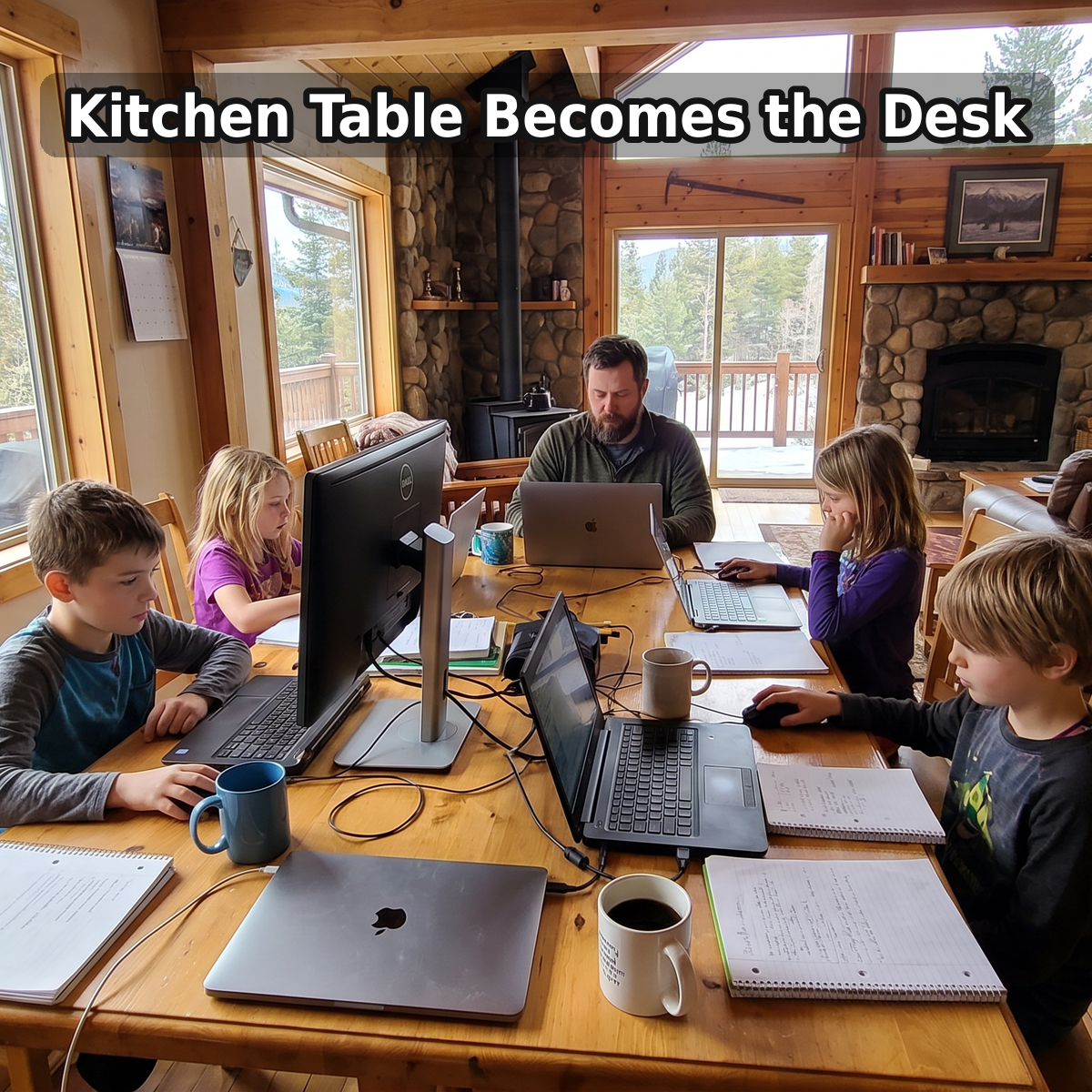
There is only one desk in this cabin, and it is also the kitchen table.
That detail felt amusing at first, maybe even a little inconvenient, the kind of thing you notice when you come to the mountains expecting rest and end up improvising a workspace around coffee mugs, chargers, notebooks, and somebody asking where the tape is. But as the week has gone on, that one table has turned into something more than a place to sit. It has become a kind of quiet workshop.
A few of my family members have gathered there each day, each working on something different, each leaning into a project, a problem, a responsibility, or an idea that matters to them. And as I have listened to the fragments of conversation, the focused silence, the occasional breakthrough, and the ordinary rhythm of people returning to their work, I have had one thought come into focus more clearly than it has in a long time:
We eventually become what we work on the most.
That may sound obvious at first, almost too simple to deserve much attention, but the longer I sit with it, the more I think it explains a great deal about how a life gets built.
The Accidental Workshop
There is something revealing about watching people work in close proximity.
Not because they announce what they are becoming, and not because they necessarily have some polished master plan, but because their attention gives them away. What they return to, what they care enough to keep shaping, what they are willing to wrestle with day after day, all of that says something. Maybe more than what they say they want.
That is what struck me at this kitchen-table-desk in the mountains. It did not feel like a grand moment. No speech was given. No one stood up and declared a personal mission statement. It was just people working. Quietly. Normally. Repeatedly.
And yet that is exactly the point.
Becoming rarely looks dramatic while it is happening.
It usually looks like this: a person sitting at a table, doing the next piece of the thing they have chosen.
Doing Is Becoming
I think we like to imagine that identity arrives in some cleaner, more final way.
We want to believe we will decide who we are, and then, almost as a separate matter, go live that out. But in practice, it seems to work the other way around. We do not merely express who we are through our daily work. We are also formed by it.
The things we work on are not neutral.
If I spend my days solving problems, I become a better problem solver. If I spend my days avoiding difficult things, I become more fluent in avoidance. If I spend my days building something useful, even imperfectly, I become a builder. If I spend my days complaining that I have not started, I become someone highly skilled at postponement.
That is the uncomfortable part of this idea, and also the liberating part.
Because if it is true that we become what we repeatedly work on, then our days are not random. They are formative. They are carrying us somewhere. They are establishing direction, reinforcing pattern recognition, and, over time, creating a kind of personal scalability in whatever habits we allow to dominate our lives.
So the question is not just, What do I want?
The deeper question may be, What am I working on so consistently that it is shaping me into its image?
It Is Not the Path, It Is the Repetition
One of the more encouraging things about this realization is that it takes some pressure off the need to pick the perfect path.
We often get stalled because we want certainty before commitment. We want to know that this is the right business, the right discipline, the right craft, the right niche, the right next move. And while those questions matter, I think we sometimes overestimate the importance of precision at the beginning and underestimate the power of repetition over time.
It really does not matter as much as we think which path we pick, provided we pick one worth pursuing and then work on it every day.
That is where the transformation happens.
Not in the initial choice by itself, though that matters. Not in the emotional rush of a new ambition. Not in the public declaration. The real force is in the repetition, in returning again and again, in practicing something long enough that it moves from activity into identity.
A person does not become a writer by admiring writing. A person becomes a writer by writing.
A person does not become a leader by liking the idea of leadership. A person becomes a leader by taking responsibility repeatedly, especially when it is inconvenient.
A person does not become disciplined by waiting for a disciplined mood. A person becomes disciplined by honoring useful commitments often enough that they begin to feel normal.
That is how this works.
We become our practiced choices.
The Trajectory Question
Maybe this is the question worth asking every so often:
If I keep doing what I am doing now, where does this lead?
Not next week. Not by the end of the month. I mean further out than that.
If I continue with these habits, these routines, these mental loops, these standards, these daily investments of attention, who will I be in five years? In ten? In twenty?
That is not meant to create anxiety. It is meant to produce clarity.
Because trajectory matters. In business, in character, in relationships, in craft, in health, in spiritual life, in every domain where compounding quietly does its work, direction tends to matter more than intensity. A short burst can be useful. A sustained pattern is transformative.
And if I do not like the trajectory, then I probably do not need a dramatic reinvention as much as I need a more honest daily practice.
That is often less glamorous, but much more effective.
You Already Made the Choice
Here is another thought that has been lingering with me while sitting in this cabin.
In many cases, we imagine that our life will change once we finally make the choice, as though choice is some singular event waiting for ideal conditions. But often the truth is that we have already made the choice, just not with a statement. We made it with repetition.
If I keep returning to something, I have chosen it.
If I keep feeding a pattern, I have chosen it.
If I keep building a skill, protecting a distraction, nurturing a business, refining an idea, or postponing an important conversation, I have made a choice, whether I used that language or not.
That realization can feel severe, but I think it is actually merciful, because it pushes life out of abstraction and back into behavior.
It reminds me that identity is not mostly a theory. It is a practice.
And that means if I want to become someone different, I do not start by waiting to feel different. I start by working differently. Deliberately. Patiently. Repeatedly.
A System, Not a Struggle
There is also something healthy about viewing this through the lens of systems rather than strain.
Not every day at the kitchen table has looked inspired. Not every work session has carried the energy of a breakthrough. Sometimes it is just people showing up, getting a little done, revisiting a problem, making progress that would be almost invisible to anyone expecting fireworks.
But that is how good systems work.
They remove some of the drama from growth.
They do not require me to be exceptional every day. They require me to be present. They ask for engagement more than spectacle. They are built on consistency, not intensity alone. And over time, that becomes a far better value proposition than waiting for perfect conditions or heroic motivation.
This matters because many people abandon worthwhile work not because the path is wrong, but because they expected the process to feel more cinematic than it does.
Usually, it does not.
Usually, it feels ordinary.
A table. A chair. A notebook. A laptop. A problem. A return to the work.
And then, much later, a life that has been shaped by those ordinary returns.
What the Table Is Teaching Me
This week in the mountains has reminded me that our lives are being built in rooms that do not look especially important while we are inside them.
A cabin kitchen can become a workshop.
A shared table can become a mirror.
A simple working session can expose something profound: we are always in the process of becoming, and the strongest force in that process is often not talent, not status, not even opportunity, but sustained attention directed toward something meaningful.
So maybe the question for all of us is not, What sounds impressive?
Maybe it is, What am I willing to work on long enough for it to shape me?
Because eventually it will.
That is the promise and the warning.
Pick Your Spot at the Table
If there is a closing lesson in all of this, it is a practical one.
Pick your spot at the table.
Choose one thing worth building, worth learning, worth practicing, worth refining. Do not overcomplicate the first step. Do not wait until your plan is flawless. Do not assume that becoming happens somewhere later, after the right circumstances finally arrive.
It is happening now.
In what you return to.
In what you tolerate.
In what you practice.
In what you keep working on when no one is applauding.
The person you will be is not being assembled in a single grand moment of transformation. More often, he is being built in quiet sessions, around ordinary tables, through repeated choices that seem small until they are not.
So choose carefully.
Then work.
And keep working.
Because sooner or later, we all become what we work on the most.