Good morning, Mr. President. Here is your Monday briefing.
The Army of the Potomac has crossed the Rappahannock. General Hooker believes he has General Lee trapped between two superior Union forces.
The casualty count is not yet known.
Good morning, Mr. President. Here is your Tuesday briefing.
General Lee has divided his army in the presence of a larger enemy. Confederate forces are moving through the wilderness. Their intentions are unclear.
Fighting has intensified.
The casualty count is not yet known.
Good morning, Mr. President. Here is your Wednesday briefing.
Confederate troops have struck the Union’s right flank. The Eleventh Corps has collapsed. Men are fleeing through the woods. Regiments have become separated. Thousands are unaccounted for.
The casualty count is not yet known.
Good morning, Mr. President. Here is your Thursday briefing.
The fighting yesterday was among the most severe of the war. General Hiram Berry is dead. General Amiel Whipple is mortally wounded. General Hooker was struck by a wooden column when a cannonball hit the porch where he was standing. He was briefly unconscious but has retained command.
The hospitals are overflowing.
The casualty count is not yet known.
Good morning, Mr. President. Here is your Friday briefing.
General Sedgwick’s force has been isolated and driven back. The wounded are being carried through rain and mud. Lists of the missing continue to arrive.
The casualty count is not yet known.
Good morning, Mr. President. Here is your Saturday briefing.
General Hooker has ordered a retreat. The army is withdrawing across the Rappahannock under cover of darkness and rain.
Some wounded men may have been left behind.
The casualty count is still not known.
Good morning, Mr. President. Here is your Sunday briefing.
The army has completed its retreat.
The Union suffered 17,304 casualties:
9,672 wounded.
5,938 missing or captured.
The Confederate army suffered another 13,460.
Thirty thousand, seven hundred and sixty-four casualties in a single campaign.
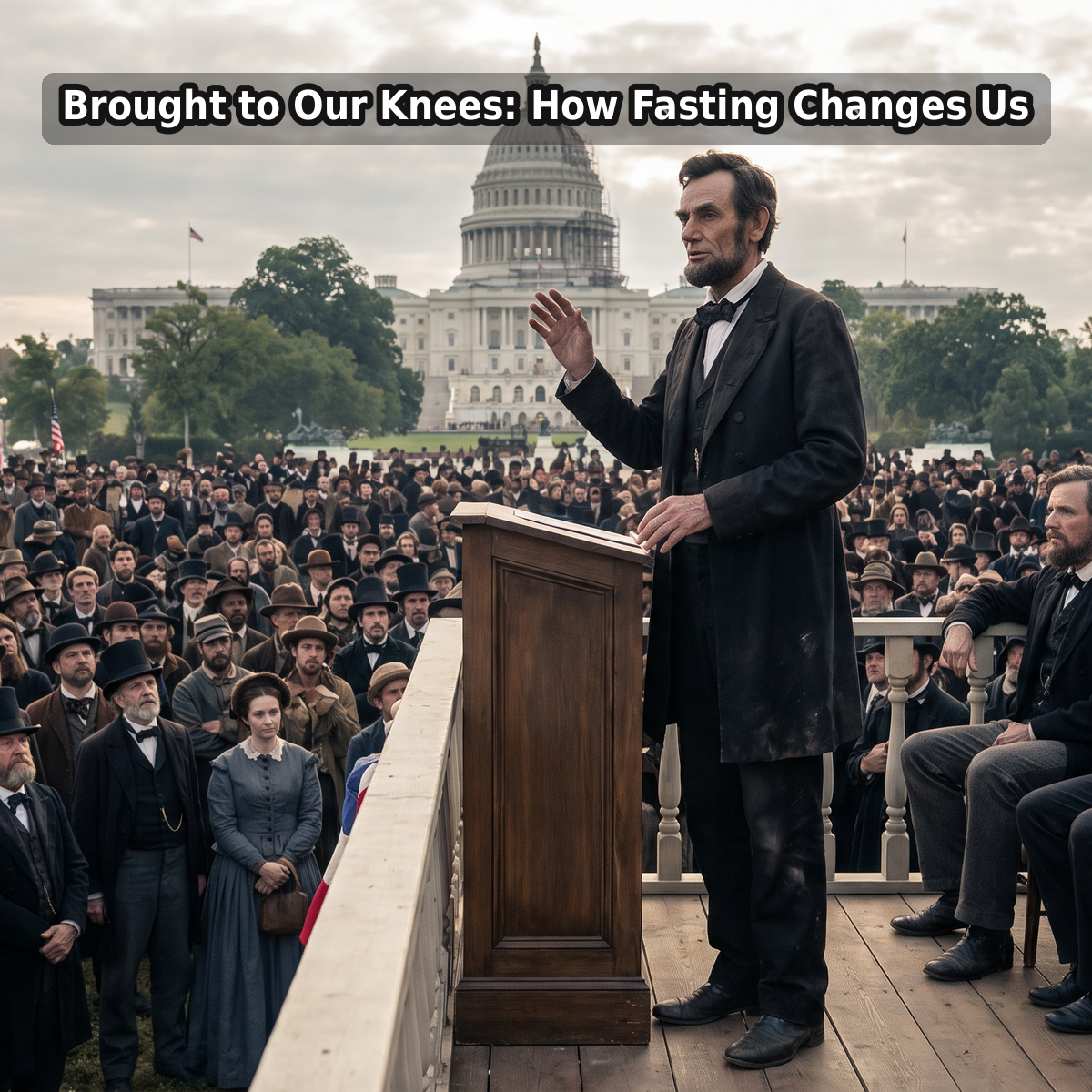
What you have just heard is not the transcript of an actual presidential briefing. It is a reconstruction of what the news from the Battle of Chancellorsville might have sounded like as it reached Abraham Lincoln.
When Lincoln received word of the defeat, a witness remembered him standing with his hands clasped behind his back, his face gray with grief, saying:
“My God! My God! What will the country say?”
This was the weight resting upon Abraham Lincoln.
He had entered office with less than 40 percent of the popular vote. He was mocked as an awkward frontier lawyer and dismissed as a country bumpkin. Newspapers and political opponents called him ignorant, grotesque, tyrannical, and incompetent.
Even many people in his own party doubted him.
He was not a conventional churchman. He never joined a denomination, and as a young man he had been skeptical of organized religion. We should not turn him into a saint or pretend he possessed perfect faith.
But the Lincoln who entered the presidency was not quite the same man who would leave it.
The war was changing him.
The death of young soldiers was changing him.
The suffering of enslaved people was changing him.
The burden of a divided country was bringing him to his knees.
On March 30, 1863, Lincoln issued one of the most extraordinary proclamations in American history. He called upon the entire nation to observe April 30 as a day of “national humiliation, fasting, and prayer.”
Listen to his words:
“We have been the recipients of the choicest bounties of Heaven.”
“But we have forgotten God.”
“We have forgotten the gracious hand which preserved us in peace, and multiplied and enriched and strengthened us.”
Then he confessed:
“We have vainly imagined, in the deceitfulness of our hearts, that all these blessings were produced by some superior wisdom and virtue of our own.”
And finally:
“It behooves us, then, to humble ourselves before the offended Power, to confess our national sins, and to pray for clemency and forgiveness.”
Lincoln was not asking God merely to crush the South.
He was not fasting as though God were a weapon to be pointed at his enemies.
He was asking the nation to repent.
He was asking whether the suffering of the war might be calling the whole country—North and South—to humility before God.
It is sometimes said that this was the last presidential call for a national fast. Technically, it was not; President Woodrow Wilson issued another during the First World War in 1918. But Lincoln’s proclamation belongs to a kind of public language almost unimaginable today: a president admitting before the entire world that national strength, prosperity, and intelligence could not save a people who had forgotten God.
And notice what happened next.
The national fast was observed on April 30, 1863—the very day the armies were assembling at Chancellorsville.
The immediate result was not victory.
It was disaster.
That matters, because fasting is not a transaction. We do not suffer hunger for a day and thereby purchase a miracle from God. God is not a machine, and fasting is not the coin we insert to obtain the answer we want.
But within roughly nine weeks, the direction of the war changed dramatically.
From July 1 through July 3, the Union stopped Robert E. Lee at Gettysburg.
On July 4, Vicksburg surrendered to General Grant, giving the Union control of the Mississippi River and dividing the Confederacy.
A succession of Confederate victories had been broken. The war was far from over, and terrible suffering remained, but the Confederacy would never again possess the same strategic opportunity.
Can a historian prove that fasting moved armies across a battlefield? No.
But we can observe the timing. We can read Lincoln’s own interpretation. And we can see what was happening inside the man.
On July 15, Lincoln proclaimed a national day of thanksgiving. He wrote:
“It has pleased Almighty God to hearken to the supplications and prayers of an afflicted people.”
He called upon the nation to thank God for the “wonderful things He has done in the Nation’s behalf,” while continuing along the paths of “repentance and submission to the Divine Will.”
Lincoln did not say, “We were stronger, and therefore we won.”
He did not say, “God has confirmed that everything we have done is righteous.”
He said that an afflicted people had prayed, that God had heard, and that the proper response was continued repentance.
That humility deepened as the war continued.
At the beginning of the war, Lincoln often spoke about preserving the Union. By the end, he was speaking about judgment, mercy, slavery, forgiveness, and the mysterious purposes of God.
Slavery was not a minor detail of the conflict. Nearly four million human beings were enslaved when the war began. As Lincoln later said, everyone knew that slavery “was, somehow, the cause of the war.”
For approximately 250 years, wealth had been accumulated through what Lincoln called the enslaved person’s “unrequited toil.”
Modern estimates suggest that roughly 750,000 soldiers died during the Civil War—through battle, wounds, and disease. The price was paid in blood, grief, empty chairs, widows, and children who would never see their fathers again.
In his Second Inaugural Address, Lincoln faced that terrible possibility directly:
“If God wills that [the war] continue until all the wealth piled by the bondsman’s two hundred and fifty years of unrequited toil shall be sunk, and until every drop of blood drawn with the lash shall be paid by another drawn with the sword… still it must be said, ‘the judgments of the Lord are true and righteous altogether.’”
That is not the language of a triumphant conqueror.
That is the language of a humbled man.
And then, after four years of hatred, criticism, rebellion, and death, Lincoln concluded:
“With malice toward none; with charity for all.”
He called the nation to “bind up the nation’s wounds,” to care for those who had borne the battle, and for their widows and orphans.
That sounds remarkably like Jesus Christ.
Lincoln had seen enough hatred to become hateful—but he called for charity.
He had endured enough ridicule to seek revenge—but he called for mercy.
He had acquired enormous wartime power—but he bowed before a power greater than his own.
Perhaps this is the greatest evidence of fasting’s power. Fasting does not always change our circumstances immediately. Sometimes it changes the person who must walk through them.
God heard the desperate prayers of an afflicted nation. I believe He still hears the prayers of afflicted people, afflicted families, afflicted churches, and afflicted communities.
But I must warn you: fasting has consequences.
Whether you consider those consequences good or bad may depend upon how tightly you are holding your present life.
If you fast sincerely, you may not receive permission to continue exactly as you are.
You may find yourself forgiving—even loving—your enemies.
You may find yourself giving some of your abundance to someone who needs it more.
You may find yourself removing a habit, possession, entertainment, or favorite distraction because God has shown you that it is occupying a place that belongs to Him.
You may become less concerned about when the next show drops and more concerned about when the next opportunity to serve appears.
You may enter the fast asking God to change your enemy, your spouse, your child, your church, your company, or your country—and discover that the first person God intends to change is you.
Jesus said in the Sermon on the Mount:
“Moreover when ye fast, be not, as the hypocrites, of a sad countenance… that they may appear unto men to fast.”
“But thou, when thou fastest, anoint thine head, and wash thy face; that thou appear not unto men to fast, but unto thy Father which is in secret.”
“And thy Father, which seeth in secret, shall reward thee openly.”
Jesus did not say, “If you fast.”
He said, “When you fast.”
So fast quietly.
Fast humbly.
Fast without attempting to manipulate God.
Fast to confess, to listen, to surrender, and to become more like Christ.
But prepare yourself.
Because when you sincerely enter the presence of God through prayer and fasting, you may not emerge with everything you requested.
You may emerge with something greater:
A softer heart.
A humbler spirit.
A willingness to forgive.
The courage to serve.
And a deeper submission to the will of God.
You may enter the fast hoping that God will change your world.
And you may discover that He has changed you.
You will not be the same person.