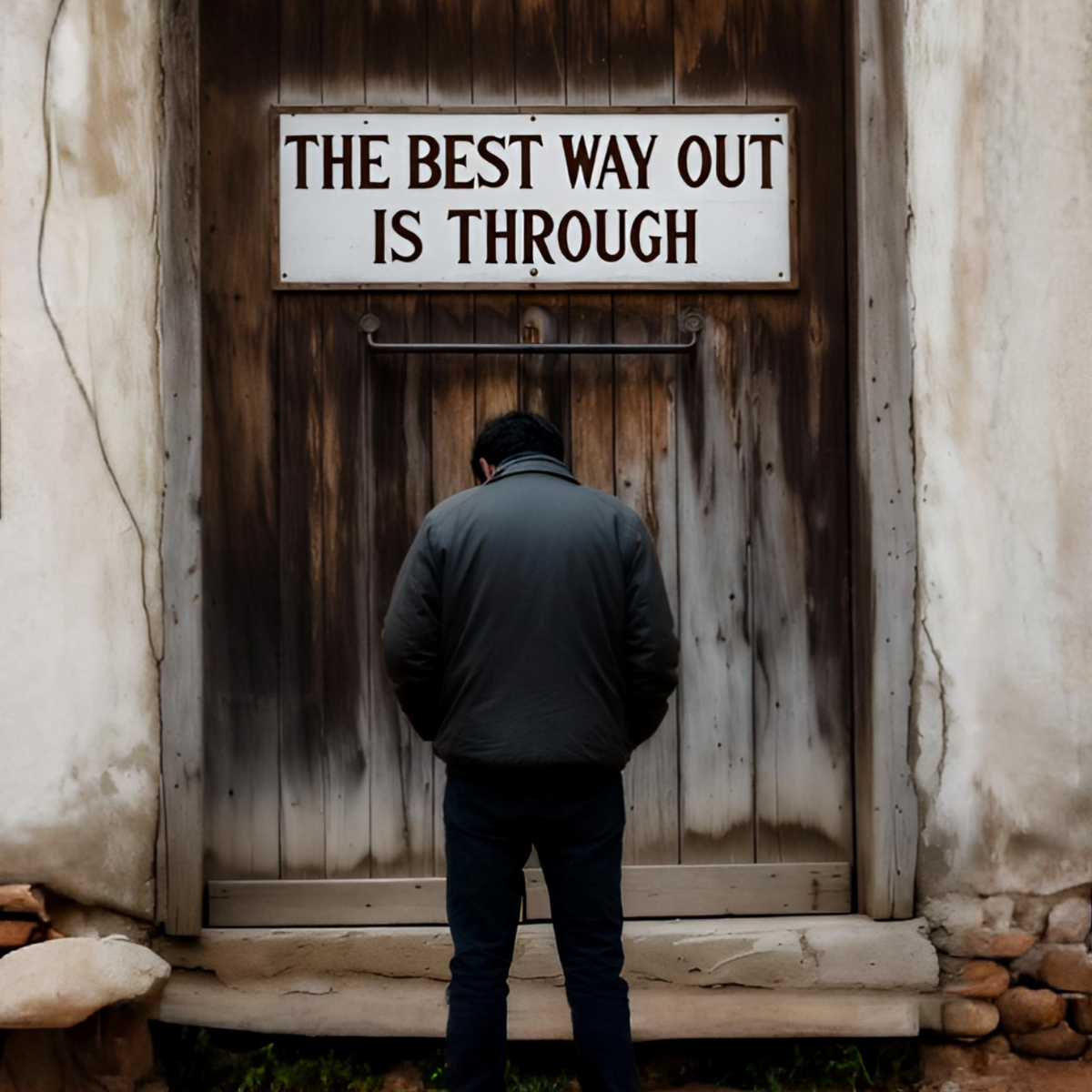
I was slumped on the couch last night, the week still clinging to me like a wet coat, when a line drifted from a show I was hardly watching. The best way out is through. It was thrown away casually, a scrap of dialogue. Still, it landed. I woke up with it this morning, and I kept turning it over like a stone in my hand. The best way out is always through.
That phrase is not a slogan; it is a compass. It does not comfort with escape. It steadies with direction. Robert Frost helped fix this idea in our language, and he did it through the voice of a woman in a house full of work. In A Servant to Servants, she names the cost of duty, the ache of being unseen, the slow squeeze of expectations that have no endings. It is not a tidy poem. It is a human one. You hear the weariness, and then you feel the quiet courage that rises when a person finally looks at the weight in front of them and decides, with no applause and no guarantees, to carry it anyway.
That is the heart of through. Not dramatic. Not easy. Just honest.
It is interesting that psychology circles back to the same doorway. Gestalt therapy, which emerged in the middle of the last century, asks us to return to the present, to feel the full shape of what is here, to take responsibility for our responses rather than orbit endlessly around our analysis. The past informs, the future invites, but the present is where change is possible. You do not sidestep the knot in your chest by thinking harder about it. You breathe, you notice, you act, you learn, you repeat. You go through.
There is something deeply practical about this. As an entrepreneur in the middle of a rough product launch, you do not need another myth about ease. You need a way to keep moving that does not lie to you. Every obstacle in front of you is data, not defeat. Market pushback is a signal. A technical issue is a teacher. A terse email from a customer is a field report. None of these are final verdicts; they are information you only earn by being in motion.
You cannot dance around this learning curve. You go through it. Each bug you resolve, each awkward conversation you have, each feature you remove because it does not serve the mission, becomes muscle. That muscle does not show up on a slide deck. It shows up in your reflexes. It shows up in the clarity of your next decision. While others are still polishing theories, you are building wisdom at the speed of contact with reality. That is an advantage you cannot buy and you cannot fake.
When I find myself stuck, I try to reduce things to the smallest next faithful step. Not the whole staircase. Just the step I can take with integrity right now. I write down what I am learning, even if the lesson is embarrassing. Especially if it is embarrassing. I allow whatever feeling is present to do its work and then I give it a job. Fear tells me where I lack a plan. Frustration tells me where I have a blocked expectation. Fatigue tells me where I need to simplify.
If you are overwhelmed today, pause long enough to tell the truth. Where are you hiding behind distractions? Where are you hoping that a clever idea will spare you the discipline of practice. Name it. Then choose the next small action that moves you through the center of the problem, not around it.
This is not about grinding yourself into dust. It is about stewardship. It is about honoring your commitments with presence and patience. It is about remembering that freedom is not out there somewhere. Freedom is on the other side of responsibility fulfilled.
Trust the process, document the lessons, and keep shipping.
The best way out is through. Not someday. Today.