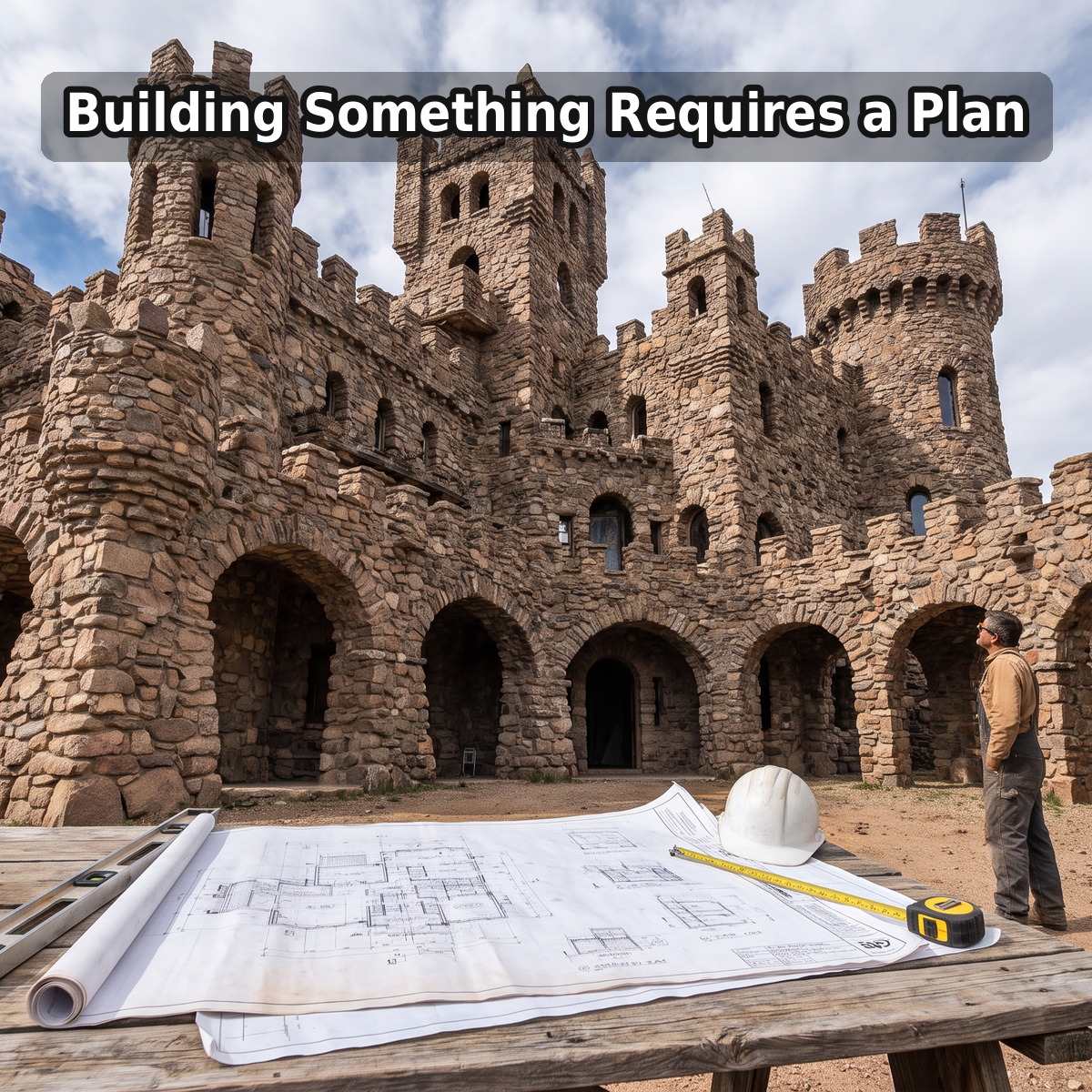
In southeast Colorado, in the mountains that rise above the city of Pueblo, sits a small parcel of land where a man named Jim Bishop started building a castle. He passed away a few years ago, and his son is now the caretaker.
The building is highly unusual, and almost nothing about it appears to follow a conventional building code. It is the result of one man building whatever he found interesting, one piece at a time. Today, it serves as a tourist destination and perhaps as a wedding venue for couples with a higher tolerance for risk than most.
But the place also serves as a reminder to me that when you set out to build something, it is probably a good idea to have at least a plan.
There is something admirable about the creativity behind the castle. It is massive, imaginative, and impossible to ignore. It exists because someone was willing to begin and keep working long after most people would have stopped. That kind of persistence is rare.
However, persistence by itself does not guarantee that what we build will be useful, safe, sustainable, or even complete.
Effort needs direction.
You can work hard every day and still create something that cannot support its own weight. You can add one more room, one more tower, one more project, or one more commitment without ever asking whether it fits with the rest of the structure. Eventually, you may have built something impressive, but not necessarily something that works.
This happens in our lives more often than we realize.
We accept responsibilities without considering how they fit into our larger priorities. We start businesses without defining what success looks like. We chase opportunities without deciding where we are actually trying to go. We add habits, goals, relationships, and obligations as they appear, hoping that someday they will all come together into something meaningful.
Sometimes they do.
Often, they do not.
A plan does not have to predict every detail. In fact, no good plan survives unchanged. Conditions shift. Problems emerge. New opportunities appear. What looked like the best path at the beginning may turn out to be impossible once construction begins.
The purpose of a plan is not to eliminate change. It is to give change a point of reference.
A plan tells you what you are trying to build. It helps you decide which opportunities belong and which ones are merely distractions. It allows you to measure whether your daily effort is moving you closer to your intended destination or simply adding more material to an increasingly complicated structure.
Without a plan, activity can easily disguise itself as progress.
You can be busy from morning until night and still move nowhere. You can spend years adding pieces to your life without ever stepping back to ask whether those pieces form the life you intended to create.
Planning forces that question.
What am I building?
Why am I building it?
Who is it meant to serve?
What must be true for it to last?
What should I stop building because it does not belong?
These questions are not restrictive. They are clarifying. They give purpose to effort.
There is also a difference between a plan and a prison. A plan should guide you, not trap you. It should be strong enough to establish direction but flexible enough to respond to reality. The best builders adjust constantly, but they adjust in service of the original vision.
They do not confuse improvisation with aimlessness.
The same principle applies to a career, a family, a company, a personal goal, or a life. You do not need to know every step before beginning. You will discover much of the path through action. But you should have some sense of the structure you are trying to create.
Otherwise, you may spend your life building towers that connect to nothing.
There is a certain beauty in Bishop Castle. It represents imagination, determination, and a refusal to wait for permission. Those are qualities worth admiring.
But when I think about what I am trying to build, I want more than something impressive.
I want something intentional.
I want the pieces to fit together. I want the foundation to support the weight. I want the structure to serve a purpose beyond proving that I had the determination to build it.
Beginning requires courage.
Continuing requires discipline.
But building something that lasts requires a plan.